Shopify B2B: Wholesale and Dealer Pricing in Your Own Store
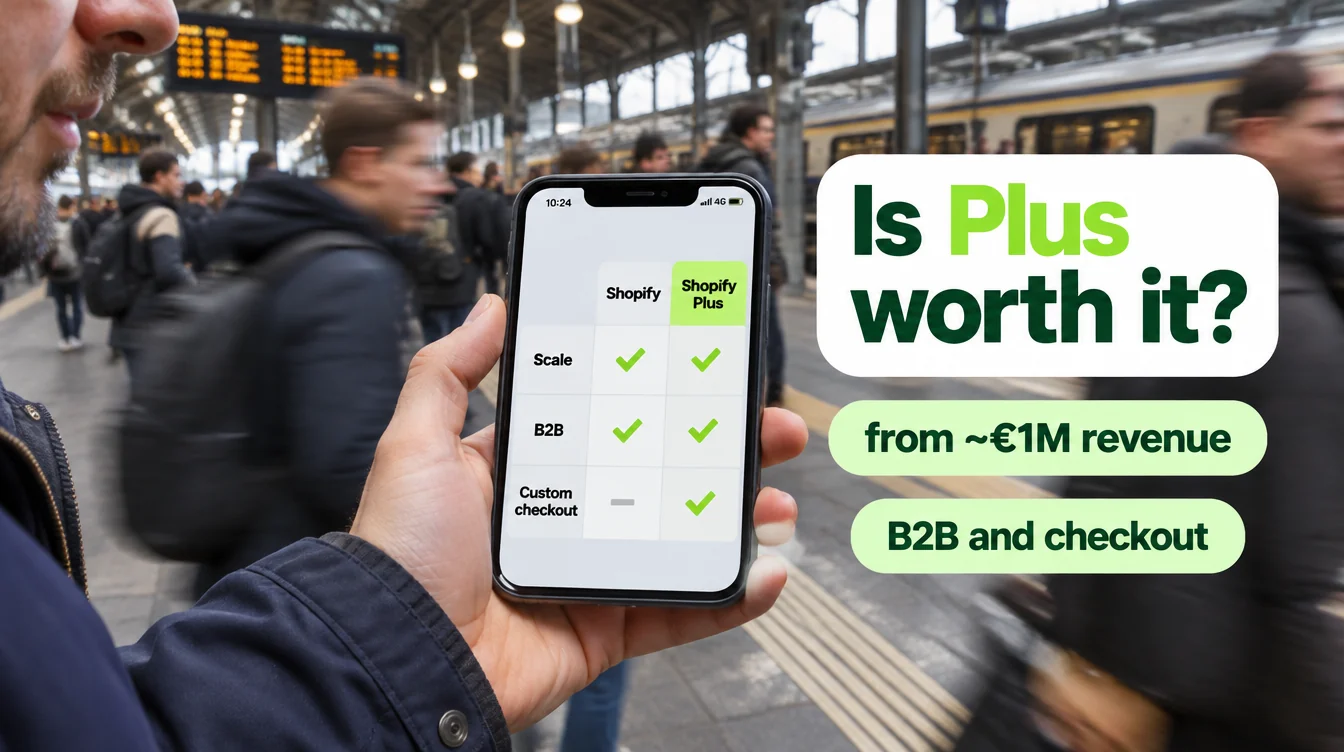
Shopify B2B from Basic: company accounts, catalogs, volume pricing, payment terms. What only Plus can do, net prices for dealers and where prices expire.

Jason Spizert
Updated on October 21, 2026
Published 9 min read
The short answer
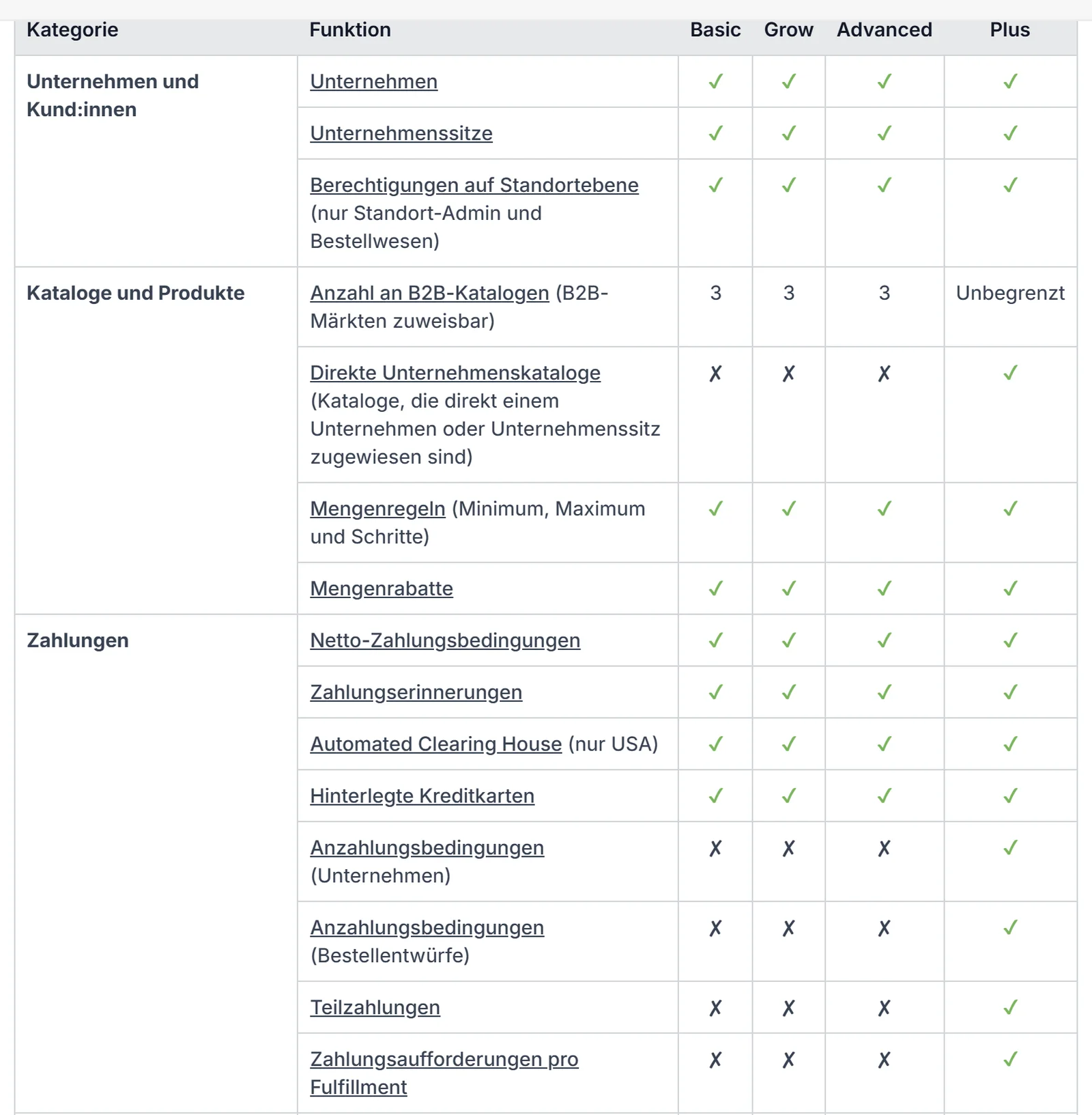
Shopify B2B is included on the Basic, Grow, Advanced and Plus plans, not on Starter and Retail. From Basic, you get company accounts with locations, catalogs with wholesale prices, quantity rules, volume pricing and payment terms up to 90 days. The difference with Plus is the price lists: Basic to Advanced allow 3 active catalogs, assigned through B2B markets, while Plus allows unlimited catalogs and prices directly per company. Only customers logged in as business customers see wholesale prices.
What can Shopify B2B do without an app?
More than most merchants expect. For a long time, B2B on Shopify was seen as a Plus topic or a case for a wholesale app. Today, company accounts, catalogs, quantity rules, volume pricing and payment terms are on every plan from Basic.
“we're looking for a B2B app, for retail customers and resellers, it should run through just one store.”Merchant with retail customers and resellers, Shopify Community, 2021 (translated from German)
The core is the catalog. It defines which products a wholesale customer sees and what they cost. Wholesale customers only see their prices once they've logged in as a contact of a company. Everyone else counts as a retail customer for Shopify.
Which Shopify plan is enough for B2B?
For most merchants with a few price groups, Basic is enough. The one hard difference: on Basic, Grow and Advanced, you have 3 active catalogs for all B2B markets combined. Only Plus allows unlimited catalogs and assigns catalogs directly to a company.
Advanced also adds contextual checkout and custom store content per market. Plus comes in when you need deposits, partial payments or payment requests per partial fulfillment. What the plans cost otherwise is covered in How much does Shopify really cost?.
Is Plus worth it for B2B? When every key account gets its own price and partial payments are part of daily business. How we set up Plus stores is shown on our Shopify Plus agency page.
B2B and B2C in one store or separate?
One shared store is the rule; a separate B2B store is the exception, with good reason. Shopify calls these a blended store and a separate store, and recommends making the choice carefully up front. If you switch later, you set up companies, catalogs and theme customizations largely from scratch.
| One store for both (blended) | Separate B2B store | |
|---|---|---|
| Admin and inventory | one admin, one shared inventory | separate admin, separate inventory |
| Theme and brand | the same theme, wholesale content via theme code or, from Advanced, in the editor | a separate theme just for wholesale |
| Payment and shipping | the same options for everyone by default | wholesale only |
| Discounts | “all customers” also applies to wholesale | apply to wholesale only |
| Tax display | one setting for retail and wholesale customers | wholesale only, so net prices are possible |
| Lock the store | not possible, retail customers must be able to order | only logged-in wholesale customers see the store |
| Apps | set up and pay once | again for the second store |
One store for both fits if …
- wholesale and retail customers buy the same products
- both are supplied from the same inventory
- the same team handles both channels
- wholesale customers can live with gross prices and a net price line
A separate B2B store fits if …
- the wholesale area has to be locked
- wholesale customers have a different range or their own inventory
- prices should be shown net to wholesale but gross to retail
- a separate team runs wholesale
The second store is a separate Shopify subscription with its own apps. Factor it in before you decide.
Net or gross: which prices do wholesale customers need to see?
In Germany, consumers must see total prices including VAT; business customers don't. The German Price Indication Ordinance only applies to prices toward consumers (Section 1(1) PAngV), and the total price includes VAT (Section 2 No. 3, Section 3(1) PAngV). So what consumers see in your store must be gross, while wholesale prices may be net. This is not legal advice; if in doubt, a lawyer specializing in e-commerce law can assess your case.
The gap is in Shopify itself. In a blended store, the setting “prices include tax” applies to everyone. If you show retail customers gross prices, wholesale customers see gross prices too.
“Currently, my stores display tax-inclusive pricing for all customers. This works well for B2C, but it makes prices appear higher for my B2B customers.”Shopify Plus merchant with B2B and B2C, Shopify Community, 2025
Per company location, you set the tax ID and tax behavior: collect tax, don't collect, or collect with exemptions. With Shopify Tax, Shopify validates the VAT IDs of companies in the EU and the UK when they are entered. In Germany, invoices to businesses are becoming e-invoices, with transition periods ending at the end of 2026 and the end of 2027 (Section 27(38) UStG).
Where does Shopify B2B have gaps?
Most leaks don't happen in Shopify B2B itself but next to it: with discounts, with products and with locks that only live in the theme. On top of that come two real limits: net price display and vetting new wholesale customers.
We've seen the login leak ourselves. In a specialist retail store, an app only locked the buy button, and classic customer accounts were set to optional. Through “Continue as guest” and a direct cart link, anyone could get into checkout. What closed it was the setting that requires login before checkout.

One limitation applies the other way. According to Shopify, buying through the Shop app can start without logging in, and every unknown email at code login creates a retail customer. If you really need to lock the wholesale area, you need a separate B2B store. If you don't know where your store stands right now, get in touch and we'll check your ordering paths.
Which apps close the gaps?
There's an app for every gap, but not every gap needs one. Max out the built-in features first, then add what's missing. As of October 21, 2026, according to the Shopify App Store:
| Gap | App | Price according to the App Store | Note |
|---|---|---|---|
| Approve wholesale customers | Shopify Forms | free | by Shopify, creates companies, approval in the admin |
| Lock pages or the store | Locksmith | from $12 a month on Basic | 4.7 stars from 306 reviews, locks by customer tag, passcode or link |
| More than 3 price lists without Plus | SparkLayer B2B & Wholesale | $0 for up to 3 price lists and 5 orders a month, then from $49 | 4.8 from 391, its own registration with approval |
| Payment and shipping methods by customer | Shopify Checkout Blocks | free | hiding and reordering only on Plus, according to the listing |
| Net price display in a blended store | Momsify B2B VAT Switcher | free to $29 a month | only 10 reviews, changes the display, not the billing |
A pricing app like SparkLayer brings its own price lists that run alongside the Shopify catalogs. Pick one route, otherwise you maintain wholesale prices in two places. Which apps are generally worth it is covered in Best Shopify apps.
Key takeaway
Count your price groups first, then choose your plan, then close the gaps. That way you don't pay for plans and apps you don't need.
How does a wholesale order get all the way to accounting?
Orders happen in Shopify; invoicing and bookkeeping happen behind it. With payment terms, money arrives in your account later, so accounting has to see open items. And in Germany, an invoice to a business will soon be an e-invoice.
 Company catalog · net 30Order with net line items and taxInventory, products, shipping statusERP (one of these)One inventory for all channels, packing slip, invoice.




 Invoice data with both tax IDsInvoice to the companyIn Germany as an e-invoice, mandatory from 2027 or 2028 depending on prior-year revenue.XRechnungZUGFeRDDocuments and incoming paymentsAccountingOpen items by payment terms, documents for your tax advisor.

 Schematic. Whether your connector carries over companies, locations, payment terms and PO numbers from Shopify B2B is something to check with a test order before you buy. The logos are examples for each role, not a recommendation or partnership. Trademarks of their respective owners.
The critical point is the connector to your ERP. Check with a test order whether company, location, PO number and payment terms come through, or just a customer with an address. How we connect Shopify to your ERP is covered on our Shopify ERP integration page.
Moving an existing wholesale store from Shopware, JTL or WooCommerce? Then companies, price groups and customer numbers belong in the migration plan, not in the time after. How we approach that is covered on our Shopify migration page.
Frequently asked questions
No. Shopify B2B is included on Basic, Grow, Advanced and Plus, just not on Starter and Retail. You only need Plus for more than 3 active catalogs, for prices directly per company, or for deposits and partial payments.
Shopify lists no separate B2B fee on its pricing page; B2B is part of the plans from Basic (€27 a month billed annually, as of October 21, 2026). Costs come from apps that close gaps and from the setup.
On Basic, Grow and Advanced, up to 3 active catalogs, combined across all B2B markets. They are assigned through markets, not directly to a company. If you want to give every key account its own price, you need Plus or a pricing app.
Yes, Shopify calls this a blended store: one admin, one inventory, one theme. Wholesale customers see their catalogs after logging in, retail customers see the regular prices. Make the decision up front; according to Shopify, switching to a separate store later means setting most things up again.
Yes, through payment terms per company location: due on receipt, on fulfillment or net 7 to 90 days. The customer pays later in their account. Shopify doesn't collect anything automatically when the term ends; you charge a saved card yourself in the admin.
In Germany, the Price Indication Ordinance (PAngV) requires total prices including VAT only toward consumers. For pure business customers, it doesn't require gross prices, and net prices are common in wholesale. This is not legal advice; if in doubt, ask a lawyer specializing in e-commerce law.
With an application form from the free Shopify Forms app. Each application creates a company that can only order once you approve it. For EU businesses, have the VAT ID confirmed first; in Germany, that's done by the Federal Central Tax Office.
No. B2B requires the new customer accounts, and wholesale customers log in with a six-digit code by email, without a password. Retail customers in a blended store can stay on classic accounts.