Shopify Alternatives 2026: When WooCommerce, Shopware, Wix or JTL Fit Better
Shopify alternatives 2026, compared honestly: WooCommerce, Shopware, Wix, JTL and Etsy with official prices, strengths, limits and the cost trap.

Jason Spizert
Updated on October 21, 2026
Published 9 min read

The short answer
The best Shopify alternative depends on your starting point: WooCommerce if your website already runs on WordPress; Shopware for complex B2B with a development team; Wix if the website is the focus and the store stays small; JTL if ERP and marketplaces drive your business; Etsy if you want to test first. None of them is truly free. WooCommerce, the Shopware Community Edition and JTL Start have no license fee, but you pay for hosting, extensions and maintenance yourself.
If you search for “Shopify alternative”, you usually have one of two reasons: Shopify seems too expensive, or it doesn't fit what you already have. Both are valid. This guide covers what the pricing pages of WooCommerce, Shopware, Wix, JTL and Etsy said on October 21, 2026, and which platform fits whom better. Shopware and JTL are German vendors with a strong base in the German-speaking market.
To be upfront: we are a Shopify partner and build almost exclusively Shopify stores. That's exactly why this guide also covers when we would advise you against Shopify.
Which platform fits instead of Shopify?
The right platform follows from your starting point, not from a feature list. Go through the questions from top to bottom. At the first yes, you have your candidate.
 store as a plugin in your existing site
 builder with bookings, blog and a small store
 B2B features in the paid plans
 store and ERP from one vendor
 Your own brand that should grow online, without you running the techThe platform handles hosting, updates and checkout. In return, you pay monthly and per sale.
If you get to the bottom, Shopify is usually the simpler choice. What speaks for and against it after many projects is covered in our Shopify review.
Which Shopify alternatives are there in 2026, and what do they cost?
The five alternatives differ mainly in who runs the tech. With Shopify, Wix and Etsy, the vendor does. With WooCommerce, the Shopware Community Edition and JTL-Shop, you or your host do.
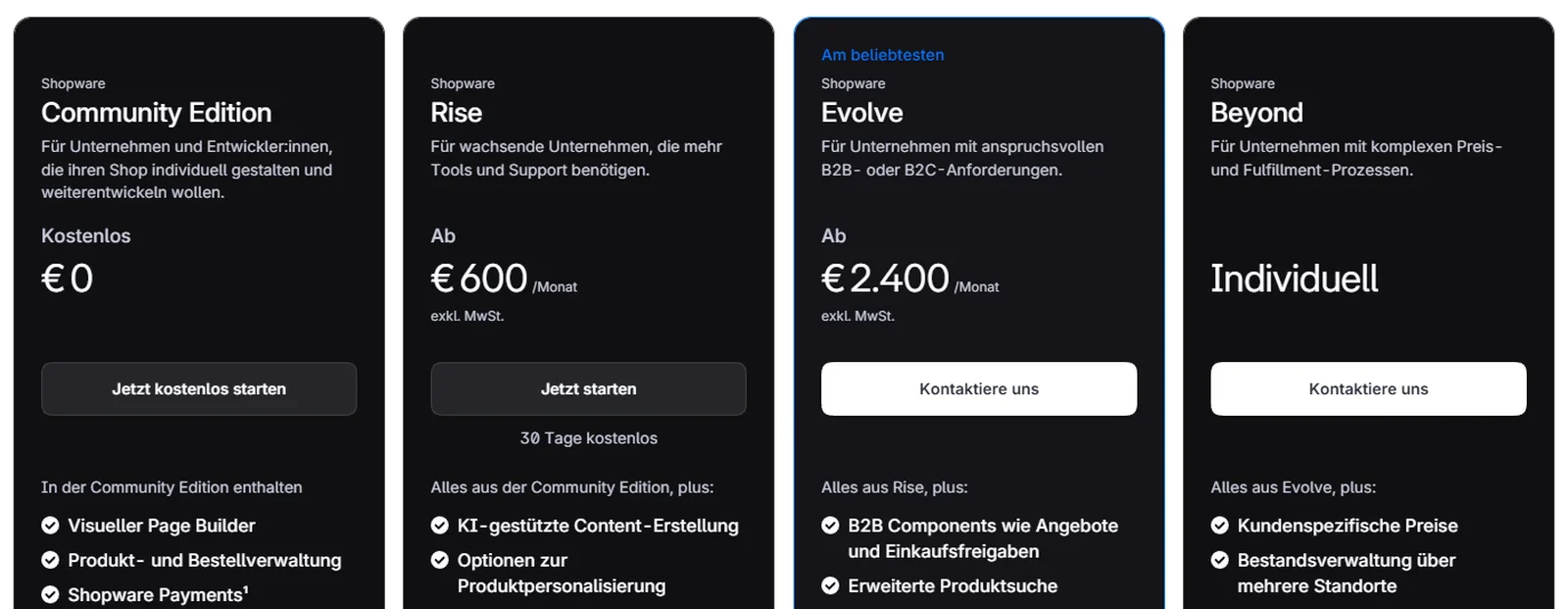
€27 a month billed annually, €36 monthlyShopify, hosting and TLS includedonline card 2.1% + €0.30 on Basic, third-party provider 2% extrathe brand should grow online and nobody wants to manage serversongoing costs for plan, fees and appssoftware €0, hosting $25 to $350 a month according to WooCommerceyou or your host, WordPress needs PHP 8.3 or neweronly your payment provider's, no revenue shareWordPress and content already carry the businessupdates, plugins and security are on youCommunity Edition €0, Rise from €600 a month plus VATyou or your host (PHP 8.2 or newer), cloud through salesdepends on payment provider, also with Shopware PaymentsB2B processes like quotes and approvals matterB2B features like quotes only in Evolve, from €2,400 a monthCore €29.75 a month on an annual plan incl. VATWixWix Payments per transaction, rate not on the pricing pagethe website is the focus, the store sits next to itthe cheapest plan, Light, can't accept paymentsJTL Start €0, basic store up to 500 productsyou or your host, JTL-Shop 5.7 needs PHP 8.3depends on payment providerinventory and many marketplaces run from one ERPmore than 500 products only from JTL Advanced, from €99 a monthEntry price per pricing page€27 a month billed annually, €36 monthlyWho runs the tech?Shopify, hosting and TLS includedFees per saleonline card 2.1% + €0.30 on Basic, third-party provider 2% extraStrong when …the brand should grow online and nobody wants to manage serversLimitongoing costs for plan, fees and appsEntry price per pricing pagesoftware €0, hosting $25 to $350 a month according to WooCommerceWho runs the tech?you or your host, WordPress needs PHP 8.3 or newerFees per saleonly your payment provider's, no revenue shareStrong when …WordPress and content already carry the businessLimitupdates, plugins and security are on youEntry price per pricing pageCommunity Edition €0, Rise from €600 a month plus VATWho runs the tech?you or your host (PHP 8.2 or newer), cloud through salesFees per saledepends on payment provider, also with Shopware PaymentsStrong when …B2B processes like quotes and approvals matterLimitB2B features like quotes only in Evolve, from €2,400 a monthEntry price per pricing pageCore €29.75 a month on an annual plan incl. VATWho runs the tech?WixFees per saleWix Payments per transaction, rate not on the pricing pageStrong when …the website is the focus, the store sits next to itLimitthe cheapest plan, Light, can't accept paymentsEntry price per pricing pageJTL Start €0, basic store up to 500 productsWho runs the tech?you or your host, JTL-Shop 5.7 needs PHP 8.3Fees per saledepends on payment providerStrong when …inventory and many marketplaces run from one ERPLimitmore than 500 products only from JTL Advanced, from €99 a monthWhat adds up on Shopify in fees and apps beyond the plan is broken down in How much does Shopify cost? Every cost, honestly calculated.
Is there a free Shopify alternative?
Without a license fee, yes; without costs, no. With WooCommerce, Shopware and JTL, the software is free. You pay for the rest elsewhere.
| Platform | What's free … | What you pay for or handle yourself … |
|---|---|---|
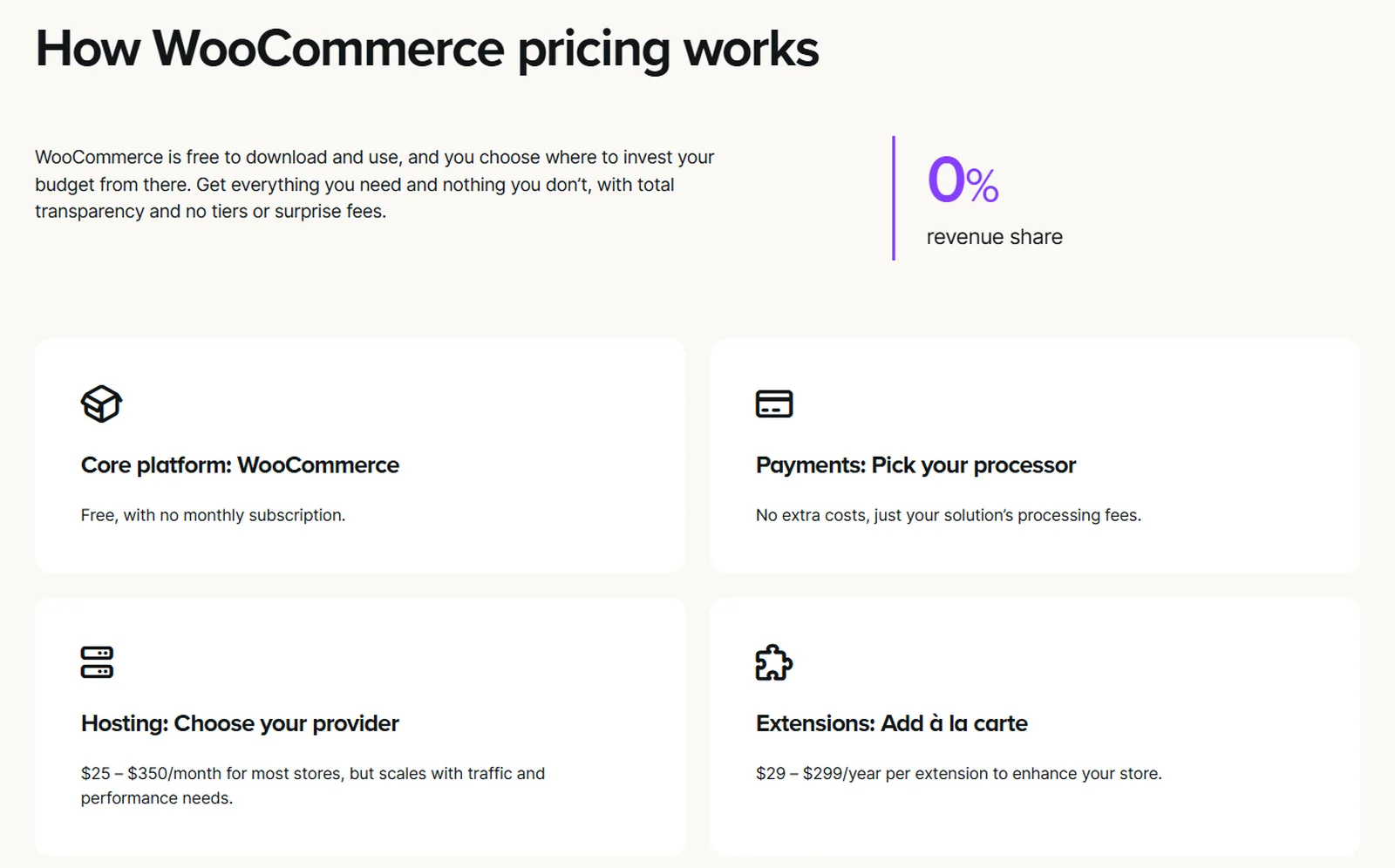
| WooCommerce | the software, no revenue share | hosting ($25 to $350 a month), extensions ($29 to $299 a year each), updates |
| Shopware Community Edition | the license | hosting, updates, only community support instead of support from Shopware |
| JTL Start | ERP and a basic store up to 500 products | web server with PHP 8.3, order packages for orders from Shopify, Shopware 6 or marketplaces |
| Wix | no plan you can sell with | from Core at €29.75 a month, Light can't accept payments |
| Etsy | the monthly fee | 6.5% per sale, 4% + €0.30 payment, $0.20 per listing |
| Shopify (for comparison) | the first 3 days | then €1 a month for 3 months, then from €27 a month |
How big the gap between “no license fee” and “free” is, WooCommerce shows itself. On its own pricing page, WooCommerce lists the typical ranges for hosting and extensions.
“"Free" is NEVER good!”Reply in a forum about starting a store, gutefrage.net, March 2025 (translated from German)
That's bluntly put, but it hits the point: with self-hosted software, you own the server, and with it every vulnerability in it. In October 2026, the PHP vulnerability that affected every PHP-based store, including WooCommerce, Shopware and JTL-Shop, showed what that means.
Key takeaway
For store software, free means no license. It doesn't mean no operations.
When are WooCommerce or Shopware the better choice?
Both are the better choice when their strength carries your business and someone reliably takes care of the tech. Without that person, freedom quickly becomes a permanent chore.
A fair point for Shopware comes from practice: at very high revenue, percentage fees weigh heavily. A merchant with one to two million euros in monthly revenue did the math like this in the Shopware forum:
“Shopware Community (free) seems to be cheaper, since the transaction fees alone at Shopify come to 4,500 EUR”E-commerce decision maker, Shopware forum, December 2024 (translated from German)
On the other side are hosting, development and support, which come on top with Shopware. Calculate both routes over two years with the same requirements. How Plus works out at that size is covered in Shopify Plus pricing, and what Shopify can do for B2B without Plus in Shopify B2B.
When are Wix, JTL or a marketplace like Etsy enough?
These three fit when the store isn't your main business, or doesn't have to be yet. Each has a clear limit.
“biggest mistake is migrating before understanding real costs. etsy takes 6.5% but handles everything. shopify charges monthly fees plus payment”Reply in the thread “Moving from Instagram/Etsy to Shopify or WooCommerce”, Reddit r/smallbusiness, October 2025
Both are true. A marketplace pays off as long as it brings you buyers. Your own store pays off when you bring in buyers yourself and want to see them again. Many merchants do both.
When is Shopify still the better choice?
When you are building your own brand that should grow online, and nobody on the team wants to manage servers. Then you'd rather pay monthly than be responsible yourself.
Shopify fits if …
- the store is your main business and should grow
- your team should sell, not manage servers
- you want your own brand with your own customer data
- you want to add marketplaces as a channel later
An alternative fits better if …
- you first want to test whether anyone buys
- your WordPress site and its content carry the business
- B2B with quotes and approvals is the core and developers are in place
- ERP and marketplaces define the store
Who this guide doesn't apply to: if your store runs on an alternative and works, switching isn't an end in itself. It needs a concrete reason.

If you are starting fresh and want to hand off the tech: Shopify store development.
Can you still switch to Shopify later?
Yes, starting with an alternative isn't a dead end. In its Help Center, Shopify describes routes for products, customers, past orders, gift cards, blogs and pages, with dedicated guides for WooCommerce, Wix and Etsy, among others.

 New store, marketplaces can be connected as channels
What decides whether a migration succeeds is usually not the products but redirects and order data. How we plan that is covered on our Shopify migration page, and for JTL specifically under JTL to Shopify. And if you first want to know where your current store loses buyers, get in touch.
Frequently asked questions
It depends on your starting point. WooCommerce if your website already runs on WordPress. Shopware for complex B2B with a development team. Wix if the website is the focus and the store stays small. JTL if ERP and marketplaces drive your business. Etsy or another marketplace if you want to test first.
Without a license fee, yes: WooCommerce, the Shopware Community Edition and JTL Start with a basic store up to 500 products. But you pay for or handle hosting, extensions, updates and security yourself. WooCommerce lists $25 to $350 a month for hosting.
As software, yes; in operation, not necessarily. Using WooCommerce's own ranges, hosting and five extensions add up to $445 to $5,695 in the first year, excluding labor. Shopify Basic costs €324 a year billed annually, plus payment fees and apps.
Shopware, if quotes, purchase approvals or prices per customer have to run in the store. According to Shopware, these features are part of Evolve from €2,400 and Beyond. For simpler wholesale pricing, Shopify is often enough, as covered in our Shopify B2B guide.
For testing, yes, because Etsy has no monthly fee and brings its own customers. In return, you pay a 6.5% transaction fee per sale and, in Germany, 4% + €0.30 for payment processing, plus $0.20 per listing. Etsy prohibits steering purchases away from Etsy to your own site.
Yes. Products and customers come along via CSV or app, past orders, gift cards, blogs and pages via app or API. What matters are redirects for every old URL so your rankings are preserved.
Not for getting started: Basic costs €27 a month billed annually, hosting is included, and after three free days the first three months usually cost €1 each. It gets more expensive through payment fees and apps as revenue grows.