Shopify Review 2026: What 150+ Store Projects Taught Us About Shopify's Pros and Cons
A Shopify review from 150+ store projects: what makes Shopify strong, where fees, apps, URL paths and checkout hit limits, and who it does not fit.

Jason Spizert
Updated on October 21, 2026
Published 8 min read

The short answer
Our experience from over 150 store projects: Shopify is the strongest choice for brands that sell to consumers and do not want to run technology. Hosting, PCI DSS Level 1 security and updates are included, and the checkout offers Apple Pay, Google Pay and Klarna without a separate integration. In return, you pay on an ongoing basis (without Shopify Payments, a 0.2 to 2% extra fee per sale, plus app subscriptions) and you accept limits: fixed URL paths, checkout apps in the first steps only with Shopify Plus, and B2B with deposits or customer-specific catalogs only with Plus.
What speaks for Shopify after more than 150 projects?
Mostly the things you never see day to day. No server that buckles on a big sales day. No plugin updates after which the cart stops loading. So anyone reviewing Shopify is really reviewing a trade: you give up control and get operations taken care of in return.
Merchants describe this trade in very similar terms again and again in reviews. One example from OMR Reviews:
“Shopify takes away the technical hurdle of programming and maintaining my own online store. That lets me focus more on my core business […]”Merchant, OMR Reviews, September 2025 (translated from German)
What the subscription includes
According to Shopify, as of October 21, 2026
Level 1
PCI DSS, the security standard for card payments
included
Hosting, unlimited bandwidth and SSL certificate
24/7
Support on every plan, prioritized with Plus
16,000+
Apps in the Shopify App Store
20
Languages per store, 30 with Plus
2,048
Variants per product, with at most three options
Sources: shopify.com/de/preise, shopify.com/de/security, apps.shopify.com, Shopify Help Center on languages and variants.
Our take: for most brands selling to consumers, this is a bigger lever than any feature on a comparison list. The time that does not go into maintenance goes into your offer, content and advertising.
How good are checkout, payments and channels?
Strong, as long as you use Shopify Payments. In Germany, it handles card payments, Apple Pay, Google Pay, Shop Pay and Klarna without a separate integration. PayPal is a separate provider, but it is exempt from the extra fee when Shopify Payments is your primary payment provider. Which checkout options you can customize on which plan is covered in Customize Shopify checkout.
 & YouTube
 Facebook & Instagram
 TikTok Shop


 Payments



 One adminProducts, inventory, orders and customers in one place
 Inventory

 Accounting
 Shipping
The channels hang off the same admin: according to Shopify, Facebook and Instagram are free to use on all plans, plus Google and YouTube, TikTok Shop, and Amazon and eBay through Marketplace Connect. One inventory, one order list.
Anything Shopify cannot do on its own comes as an app. Before you install, take a look at the Shopify apps you really need. Shopify now handles many tasks without an extra subscription.
What does Shopify really cost day to day?
More than the plan. Once revenue is flowing, the monthly price is the smallest line item. Fees per sale grow with your revenue, and every app is a separate subscription on your Shopify bill.
| Plan | per month, billed yearly | billed monthly | Online card payments with Shopify Payments | Extra fee without Shopify Payments |
|---|---|---|---|---|
| Basic | €27 | €36 | 2.1% + €0.30 | 2% |
| Grow | €79 | €105 | 1.8% + €0.30 | 1% |
| Advanced | €289 | €384 | 1.6% + €0.30 | 0.6% |
| Plus | from €2,100 (3-year term) | from €2,250 (1-year term) | 1.3% + €0.30 | 0.2% |
A worked example: at €30,000 in monthly revenue on the Basic plan without Shopify Payments, 2% comes to exactly €600 a month. And that is on top of what your payment provider charges itself.
“The monthly fees as well as transaction fees and costs for third-party apps add up quickly, which is especially noticeable with the thin margins in dropshipping.”Store owner, OMR Reviews, November 2024 (translated from German)
The full calculation with apps, theme and build for €5,000, €30,000 and €150,000 in revenue is in What Shopify really costs.
Where does Shopify hit its limits?
In four places that we clarify before every project starts. None of them is a deal breaker. But each one gets expensive if it only surfaces after launch.
URL structure
On Shopify, collections live under /collections/, products under /products/ and content pages under /pages/. You can choose the part after that freely. In its Help Center, Shopify explicitly calls /products and /collections “fixed Shopify paths”.
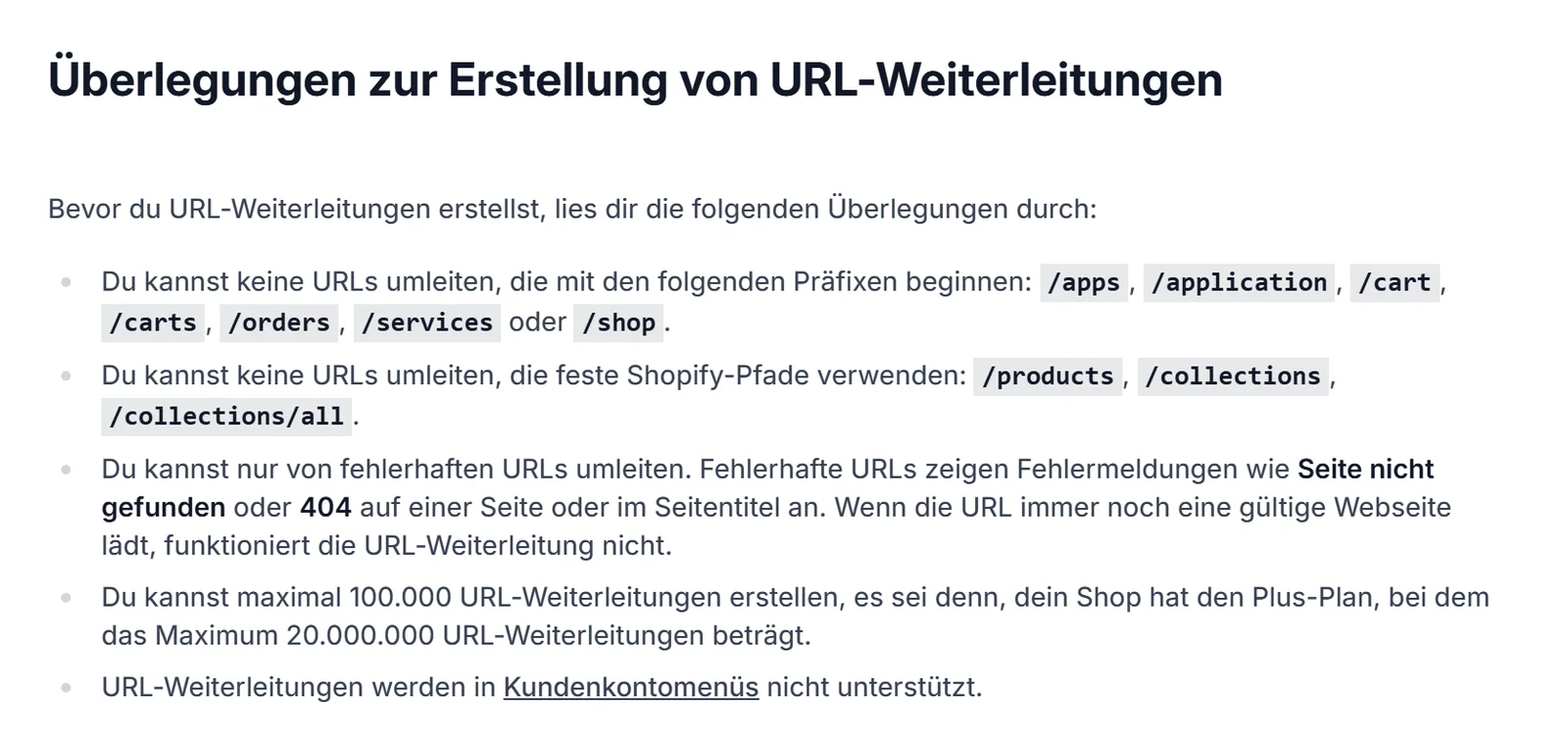
For a new store, this does not matter. For a migration with established rankings, it means every old address needs a redirect. How to do that without losses is covered in Switching store platforms without losing rankings.
Checkout
You can adjust logo, colors and fonts on every plan. Extra functionality via apps, such as an additional field or a notice in the payment step, is only possible in the information, shipping and payment steps with Shopify Plus. From Basic, apps are only possible on the thank-you and order status pages.
For most stores, the standard checkout is enough, and that is exactly why it is fast. If you need custom logic in the checkout, factor in Plus from the start. When that pays off is described on our Shopify Plus agency page.
B2B
B2B is not reserved for Plus. Company accounts, net payment terms, quantity rules and volume pricing are available from Basic. The limit is in the details: on plans below Plus, you get at most three B2B catalogs, no catalogs assigned directly per customer, no deposits and no partial payments. What B2B can do on which plan is covered in detail in Shopify B2B: wholesale and dealer pricing.
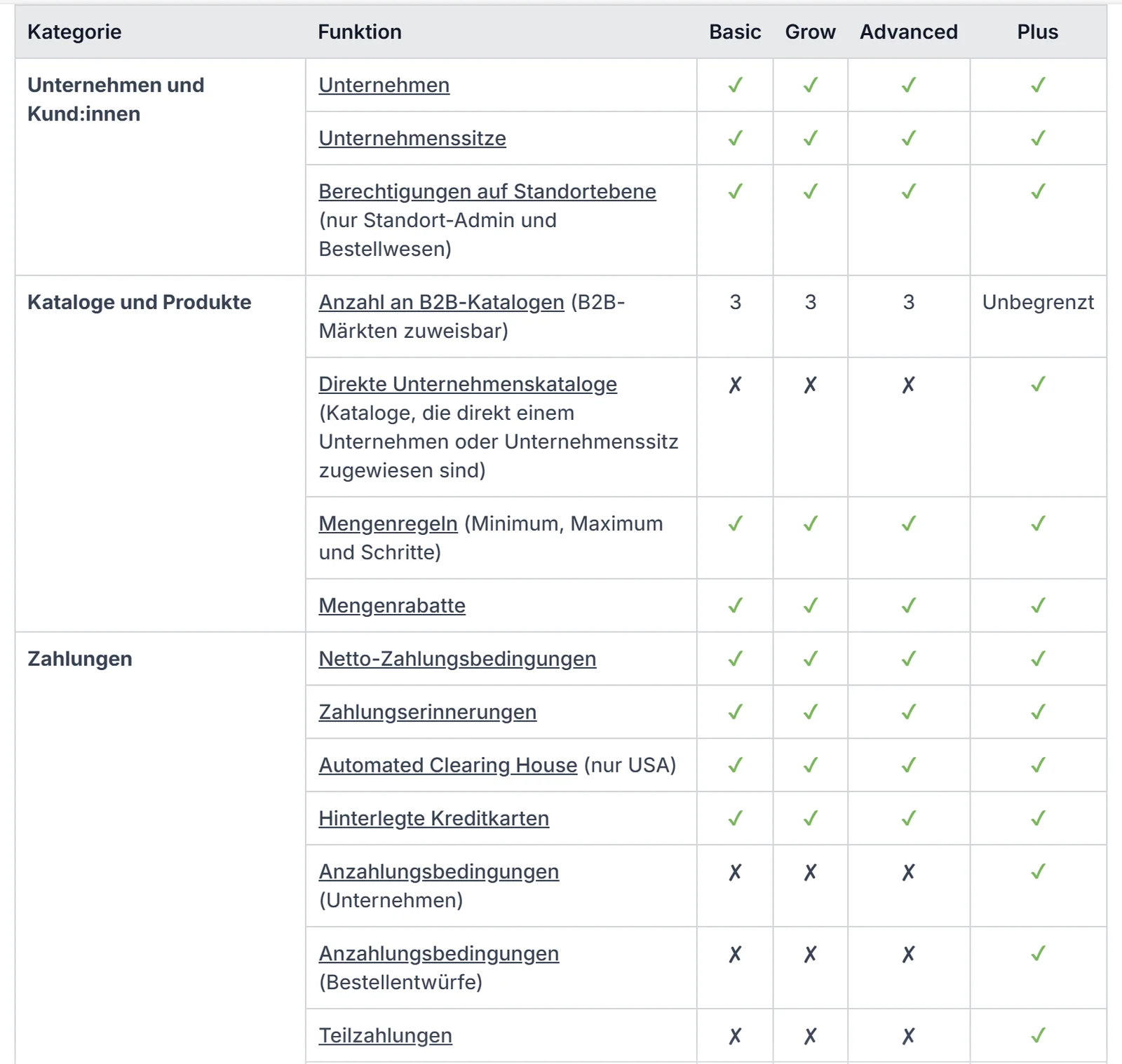
A store with a few wholesale customers and one price list does fine with this. A wholesaler with price lists per customer and deposits ends up on Plus or another system.
Payment account
Shopify Payments reviews accounts for their entire lifetime. According to Shopify, an account can be put on hold because of missing information, incorrect bank details or an industry that is not permitted, for example. When risk is elevated, Shopify holds back a reserve. Triggers Shopify names include many chargebacks, long delivery times, pre-orders and a sudden sharp increase in volume.
“We have been running a nicely growing store for about 3 months, with more and more customers. But then Shopify switched off Shopify Payments without any warning, saying the store was being reviewed.”Store owner, Shopify Community, August 2024 (translated from German)
This mainly affects fast-growing stores and pre-sales. So complete all your details before launch and keep a second payment method like PayPal ready.
Who is Shopify not right for?
For businesses whose core sits outside the standard. That does not mean “never Shopify”. It means: check these points first, then decide.
Shopify fits if …
- you sell your own products to consumers
- your team should be selling, not looking after servers
- you can use Shopify Payments
- you want to serve several channels from one inventory
Shopify is less likely to fit if …
- you cannot use Shopify Payments and run on thin margins
- your core is a configurator with more than three options per product
- you run wholesale with price lists per customer and deposits, without wanting Plus
- servers and data have to sit with you because of a requirement
If WordPress or Shopware are already in the picture: WooCommerce vs. Shopify and Shopify vs. Shopware compare both paths in detail.
What have we learned from more than 150 store projects?
In our view, many bad experiences with Shopify do not originate in the platform but in the order of things: when payment method, app list and redirects only get planned after launch. Then Shopify feels expensive or inflexible, even though only the planning came too late.

Two paths from our projects: for Whisky Agents, we moved from WooCommerce to Shopify, with a custom brand world and several language versions. For Koluré, the store was already running on Shopify, and the job was a redesign. Both times, the platform was not the question. What gets built on it was.
Our verdict
Shopify takes operations off your hands, not the work of selling. Plan for that, and you will have good experiences with Shopify.
If you are starting fresh, our Shopify store development page shows how we plan a store from plan choice to launch. If you are coming from another system, the process is described under Shopify migration, with dedicated pages for the most common paths from WooCommerce and Shopware. If your store already runs on Shopify but looks dated, a Shopify redesign is the way to go. And if your Shopify store is live but not selling the way it should, conversion optimization is the faster starting point. Everything together is on our Shopify agency page.
Frequently asked questions
Yes. Hosting, security, SSL certificate and updates are included in the subscription, and the Basic plan costs €27 per month when billed yearly. Still, plan for the fees per sale and the apps you need from day one.
The running costs and the fixed limits. Without Shopify Payments, a 0.2 to 2% extra fee applies to every sale, many features cost an app subscription, products and collections live under fixed paths like /products/ and /collections/, and checkout apps in the information, shipping and payment steps are only available with Shopify Plus.
Not if Shopify Payments is your primary payment provider. In that case, according to Shopify, PayPal payments are exempt from the extra fee for third-party providers. If you do not use Shopify Payments, the fee applies depending on your plan.
The last part of an address, yes; the path in front of it, no. Shopify calls /products and /collections "fixed Shopify paths". When you move from another system, every old address therefore needs a redirect. Up to 100,000 are possible, up to 20,000,000 with Plus.
Yes, from the Basic plan: company accounts, up to three B2B catalogs, net payment terms, quantity rules and volume pricing. Catalogs assigned directly per company, deposits and partial payments are only available with Shopify Plus.
Shopify Payments reviews accounts for as long as they exist. According to Shopify, reasons for a hold include missing information, incorrect bank details or an industry that is not permitted. Shopify sets reserves when risk is elevated, for example with many chargebacks, pre-orders or a sudden sharp increase in volume.
Yes. Products, customers and orders can be exported as CSV files. Design and app functionality are tied to Shopify and get rebuilt in the new system.