How to Calculate CAC: What a New Customer Really Costs Your Store
Calculate CAC: the formula, which costs belong in it, blended vs. channel CAC, finding new customers in Shopify and a calculator. Example: €40 turns into €56.

Jason Spizert
Updated on October 21, 2026
Published 7 min read

The short answer
Here is how you calculate CAC (customer acquisition cost): all costs of acquiring new customers in a period divided by the number of new customers in the same period. Costs include ads across all channels, agency, creators, new customer discounts and prorated tools. You count new customers in Shopify, not in the ad account. Example: €5,600 in costs and 100 new customers make €56 per new customer.
How do you calculate CAC?
With one division: cost of acquiring new customers divided by new customers, both from the same period. The formula is simple. The hard part is the two numbers you put into it.
"Now you: what does a new customer cost you?"Founder of a D2C brand, LinkedIn (translated from German)
An example. Kanto sells e-bike accessories. In October, the store spends €4,000 on ads, plus agency, creators, discounts and tools. Shopify counts 100 new customers. The costs sit in six accounts, the new customers in only one place:
 Meta€2,800
 Google Ads€900
 TikTok€300
 Creators€500
 Discounts€360Agency, tools€740
 "New vs. returning customers" report: 100 first-time customers this month100
If Kanto counts only ads, the CAC comes out at €40. With all costs, it is €56, which is 40 percent more. That is not a rounding error. It is the question of whether a new customer makes money or costs money.
Which costs belong in CAC?
Everything you spend so that someone buys for the first time. What you spend on existing customers, or what every order costs anyway, stays out. The line is not always sharp, so one thing matters most: you calculate the same way every month.
| Item | In CAC? | Why |
|---|---|---|
| Ad spend, all channels | Yes | Meta, Google Ads, TikTok, Pinterest: everything in the same month, net. |
| Agency, freelancers | Yes, prorated | Only the part that works on new customers. Not the upkeep of emails to regular customers. |
| Creators, influencers | Yes | Fees, commission and the purchase cost of gifted products. |
| Discounts for new customers | Yes, or in the contribution margin | Welcome codes cost money. But count them in one place only, never twice. |
| Advertising tools | Prorated | Creative tools, tracking, landing page builders. |
| In-house marketing team | For full CAC | If you include salaries, you see the real costs. What matters is doing it the same way every time. |
| Product cost, shipping, payment fees | No | These apply to every order and are part of the contribution margin. |
| Emails and loyalty program for regular customers | No | Those are retention costs, not acquisition costs. |
Discounts are where the most common double-counting happens. According to its own help center, Shopify calculates average order value after discounts. If you build your contribution margin on that value, the discount is already included there and does not belong in CAC a second time.
"If you burn your margin in fulfillment, you have nothing left to fight back with in marketing."E-commerce practitioner with food D2C experience, LinkedIn (translated from German)
What the ads themselves cost and what drives the price per purchase is covered in the article How much do Instagram and Facebook ads cost?
Blended CAC or channel CAC: which one is right?
Both, for different questions. Blended CAC divides all costs by all new customers. It shows whether your business holds up, and it cannot count anything twice. Channel CAC divides a channel's costs by that channel's new customers. It shows where the next euro should go.
The catch with channel CAC is attribution. According to its help center, Shopify offers several models: first click, last click, last non-direct click and any click. With the "any click" model, every channel involved gets credited with the full order, so the total is larger than the number of orders. Why Meta, GA4 and Shopify show different numbers anyway is explained in the article Shopify, GA4 and Meta show different numbers.
Rule of thumb for steering
Whether you make money is decided by blended CAC. Where the budget goes is decided by channel CAC. You need both, but not for the same question.
Where do you find your new customers in Shopify?
In the "New vs. returning customers" report. There, Shopify counts first-time customers separately from returning ones for each period. According to Shopify, a first-time customer is someone who placed their first order in your store.
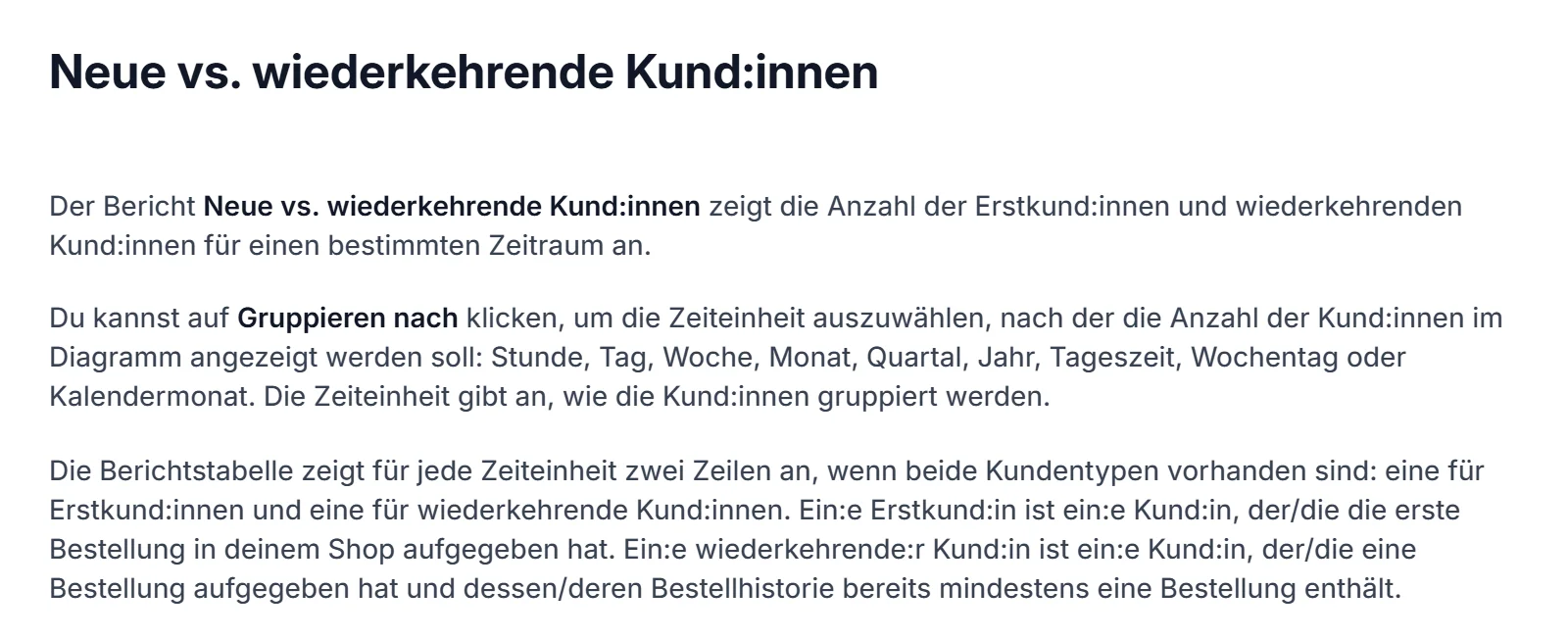
The same help page contains a trap: customer reports use the entire order history. Someone who buys for the first time in November and again in December shows up as returning in a November report, according to Shopify. If you look up old months later, the numbers may have shifted. So always record your new customers at the same point in time.
For channel CAC, the customer cohort analysis helps. There, you filter the first order by marketing channel and see how many new customers a channel brought in.
Which mistakes make CAC look too good?
Two mistakes that push in the same direction: the numerator is too small or the denominator too large. Both lower CAC, and neither stands out, because the number looks good. At Kanto, the same data produces four values between €31 and €56.

Counting existing customers. If you divide by all orders, you get the regular-customer bonus for free: they buy anyway and push the number down. At Kanto, CAC drops from €56 to €32 this way. Looking at only one ad account. Cost per purchase in Meta Ads Manager includes neither Google nor creators, and Meta counts purchases by its own attribution. How Meta, Google and Shopify calculate is shown in the article How to calculate ROAS.
"Customer acquisition costs and marketing costs in general were still much lower, which meant our margin was higher."Co-founder of a jewelry brand, LinkedIn (translated from German)
When has a new customer paid for themselves?
When their contribution margin overtakes CAC. Divide CAC by the contribution margin per order and you know how often a new customer has to buy. At Kanto, one order brings in €32.
With a €40 CAC, Kanto looked profitable. With €56, the store does not earn the costs back even in the first year. How a customer's value grows over 12 months and which CLV to CAC ratio makes sense is covered in the article How to calculate customer lifetime value. Run it with your numbers:
If your CAC is above your CLV, there are three levers: cut costs, raise the contribution margin per order or win more repeat purchases. Where the budget can be steered, take a look at our approach to performance marketing. Where visitors drop off before their first purchase, the lever is conversion optimization.
When is this calculation not enough?
When the numbers are too small or new customers do not end up in your store.
Calculating monthly is enough if …
- you have enough new customers every month that one more or less does not tip the number.
- your costs fall in the same month in which they take effect.
- almost all orders go through your Shopify store.
- you keep the cost list the same way every month.
Calculate differently if …
- you only have a handful of new customers a month. Then calculate per quarter.
- a big creator deal or a trade show falls in one month but works over several. Then spread the costs.
- many customers buy via Amazon or retail. They do not show up in Shopify as new customers.
- you sell a subscription. Then what counts is how long customers stay, not just the first order.
Whether your store is already losing customers before the ads even matter is what our conversion optimization finds out.
Key takeaway
CAC is not what your ad account shows per purchase. It is everything you spend on a new customer, divided by the new customers Shopify counts.
Frequently asked questions
Divide all costs you spend in a period on acquiring new customers by the number of new customers in the same period. €5,600 in costs and 100 new customers give you a CAC of €56.
Ad spend across all channels, the share of agency or freelancer work that wins new customers, creator fees and gifted products, discounts for new customers and prorated tools. Product cost, shipping and payment fees do not belong in it; they are part of the contribution margin.
Blended CAC divides all costs by all new customers and shows whether your business holds up. Channel CAC divides a channel's costs by the new customers attributed to that channel. It helps you allocate budget, but depends on the attribution model.
Under Analytics, Reports, category Customers, in the "New vs. returning customers" report. It shows first-time customers separately from returning ones for each period.
No. Meta only divides Meta's costs by the purchases Meta attributes to itself, existing customers included. CAC takes all costs and divides by the new customers from your store.
When it is higher than the contribution margin a customer brings you in 12 months. If it is above the contribution margin of the first order but below that, you front money and earn it back through repeat purchases.
Monthly, if you have enough new customers that individual outliers do not tip the number. With only a few new customers a month, you are better off calculating per quarter.