How Much Do Instagram and Facebook Ads Cost? Meta Ads 2026, Calculated Realistically
How much do Instagram and Facebook ads cost? The auction, cost per purchase, budget and the iPhone fee when you boost a post. With a calculator.

Jason Spizert
Updated on October 25, 2026
Published 6 min read
The short answer
An ad on Instagram or Facebook has no fixed price. You set a budget, and Meta auctions every single impression. In Germany, 1,000 impressions recently cost between about €6 and over €30, depending on the source and month. What really matters is what a purchase costs: that is decided by your creative, your offer and your store. Your budget has to be big enough for Meta to see about 50 purchases per week and learn from them.
How much does an ad on Instagram and Facebook cost?
As much as you want to spend. Meta does not sell ads at a list price. You set a daily or lifetime budget, and for every possible impression an auction decides which ad someone sees. You book Instagram and Facebook together in Ads Manager.
According to Meta, the highest bid does not simply win. The ad with the highest total value across three factors does. A more relevant ad can beat a higher bid this way. That is why two stores with the same budget pay completely different prices.
Remember this
You decide the budget. What you get for it is decided by your ad and your store.
What do 1,000 impressions and a click cost in Germany?
Roughly €6 to €15 for 1,000 impressions, and considerably more in strong months. The published values vary widely, because each source analyzes different accounts, goals and time periods. These figures are for the German market:
| Source and date | CPM (1,000 impressions) | CPC (click) | Click-through rate | Basis |
|---|---|---|---|---|
| Superads, Germany, July 2025 to July 2026 | Median €9.81 to €32.28, average about €14.80 | Median €0.76 to €1.33, average about €0.91 | Median 1.23% to 3.30%, average about 1.68% | Ad accounts of Superads users, median values |
| Zweidigital, as of October 2026 | about €6 | about €0.40 | about 1.5% (2022 value) | Median across more than 100 client accounts of one agency, link clicks only |
| Ostend Digital, April 2026, e-commerce benchmarks | €6 to €12 | €0.30 to €0.90 | 1.2% to 1.8% | An agency's benchmarks without a disclosed data basis |
Three things explain the range: season, campaign goal and counting method. In the Superads data, the German median was €23.74 in November 2025 and €9.81 in February 2026.
How do you get from impressions to cost per purchase?
With three numbers: CPM, click-through rate and conversion rate. Cost per purchase = CPM ÷ (1,000 × click-through rate × conversion rate).
Here is an example with Kanto, a store for e-bikes and accessories. Kanto advertises a handlebar bag for €89 and assumes a €10 CPM, a 1% click-through rate and a 2% conversion rate. What a realistic rate is for your store is covered in our article on a good Shopify conversion rate.
Whether €50 per purchase is too much depends on your margin. At a 50% contribution margin, the bag brings in €44.50, so every purchase through the ad costs €5.50 more than it earns.
How to calculate your break-even point is explained in our article on ROAS. If you have repeat customers, you can afford to acquire first purchases below break-even. How far below is shown by your customer lifetime value. Plug in your own assumptions:
How much budget do you need at the start?
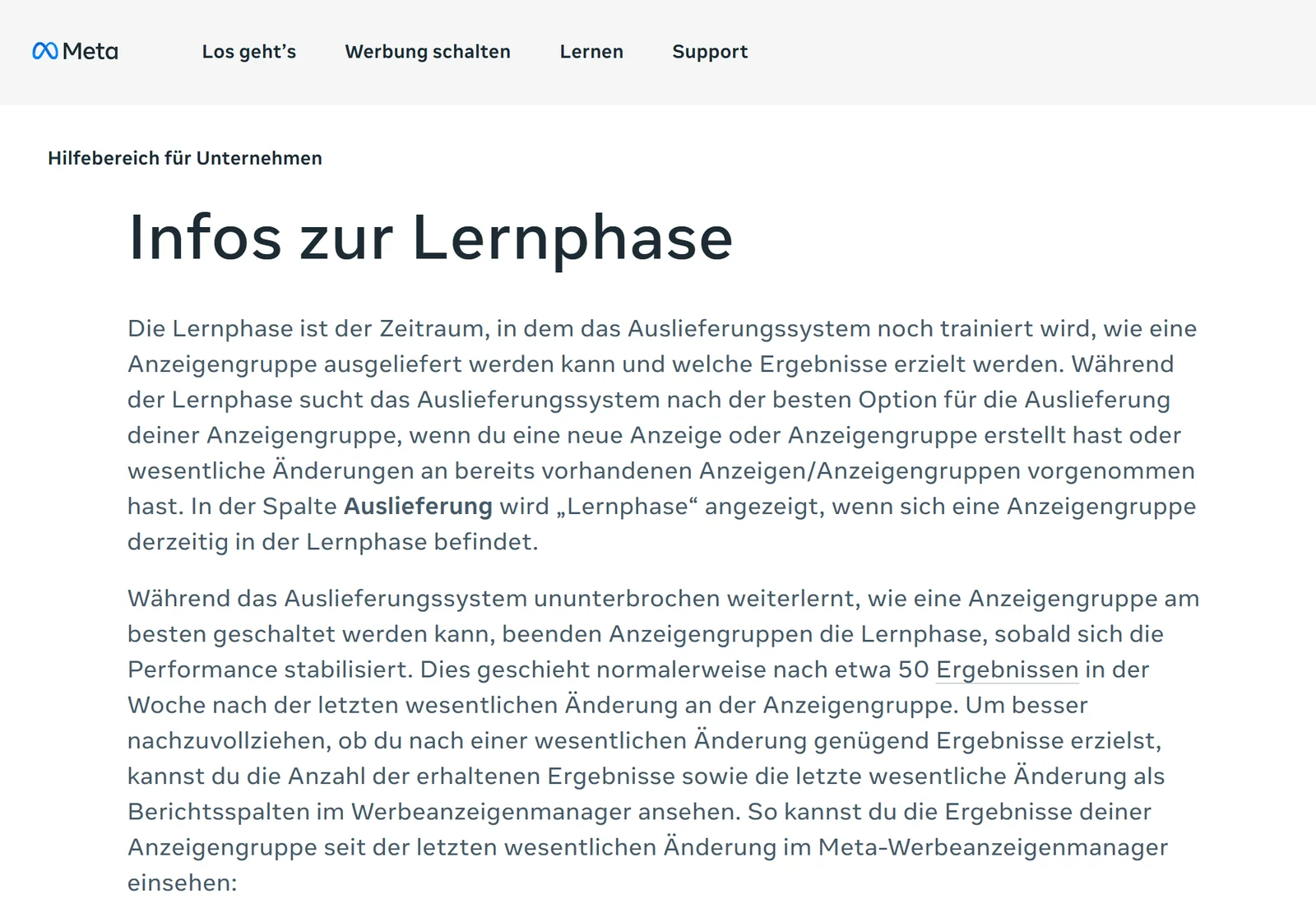
Enough for Meta to see about 50 purchases per week. According to Meta, an ad group usually exits the learning phase after about 50 results in the week after the last significant edit. Before that, results fluctuate and a purchase is usually more expensive.
This leads to a rule of thumb, derived by us and not a Meta requirement. For the €3,290 e-bike, assume only 0.2% of visitors buy; hardly any young store can carry that. In that case, Meta itself recommends a more frequent event such as “Add to cart” as the goal.
“Hey, we have now spent a good 250 euros on FB and IG within a month and despite 200 visits not even one person added something to the cart, let alone any sale.”Store owner, Shopify Community (translated from German)
At €50 per purchase, €250 is mathematically enough for five purchases a month. Meta learns next to nothing from that. 200 visits without a single add to cart point more to a problem after the click, as described in our article Lots of traffic, no sales. A small budget mainly buys insight into your creative and your store, not predictable purchases.
The rule does not apply if you only want to get the word out about a promotion. In that case you optimize for reach or clicks and measure success differently.
How much does it cost to boost a post directly in the Instagram app?
Here, too, you set the budget yourself. The fastest way is a post you have already published. According to Instagram's help pages, it works like this:
- Switch your profile to a business account.
- In your profile, tap Professional dashboard, then Ad tools.
- Select the post you want to boost; a story works too.
- Set the goal, audience, budget and duration.
- Tap “Boost post”. Meta reviews the ad, then it runs.
iPhone cost trap
If you top up your ad balance through the Instagram app for iOS, Apple keeps 30% of your ad spend. Through instagram.com in the browser, this fee does not apply.
For a store, the app route has a limit: the only goals there are more profile visits, more website visits or more messages. You can only optimize for purchases in Ads Manager. A website visit is not a purchase yet, so the price per visit says little about what a customer costs you.
What determines the cost of a purchase?
Four things, and the budget is not one of them. Meta even writes that cost per result can rise when your budget is much higher than usual: the system uses the cheapest opportunities first.
“We pay €65 for a new customer through Meta ads. The bra costs €14 to make.”Founder of a lingerie brand, LinkedIn (translated from German)
That is how high the price of a new customer can get, even for a well-known brand. The bigger lever is often behind the click. Whether your product page is losing buyers is something we look at in our conversion optimization work. Whether a new creative is really better is settled by a clean A/B test.

What costs come on top of the ad budget?
The ad budget goes straight to Meta. Next to it are four items that many people only notice after launch.
 Ad budgetGoes straight to Meta. The only number you set in advance.
How we set up ads, creatives and landing pages together is described on our performance marketing page, and everything about Facebook and Instagram on our Meta ads agency page. We build the store your clicks land on as a Shopify agency.
Is TikTok cheaper than Meta?
Not in principle. TikTok also auctions its ad placements, and there too the price per purchase depends on creative and store. We have not found a reliable, dated figure for TikTok prices in Germany.
Meta TikTok
 demands videos that look like TikTok. If you cannot produce them, you will end up paying more there.
Frequently asked questions
There is no fixed price per ad. You set a budget, and Meta auctions every impression. In Germany, 1,000 impressions cost between about €6 and over €30, depending on the source and month. What counts is the price per purchase, and that depends on your creative, your offer and your store.
As much as you set as your budget. When you boost a post in the app, you choose the goal, audience, budget and duration yourself. Watch out on iPhone: if you top up your ad balance through the Instagram app for iOS, Apple keeps a fee of 30% of your ad spend, according to Instagram's help pages. Through instagram.com in the browser, this fee does not apply.
No. When you boost directly on Instagram, according to Instagram's help pages your goal options are more profile visits, more website visits or more messages. For campaigns that optimize for purchases in your store, you need Meta Ads Manager.
You book both in the same Ads Manager. With Advantage+ placements, Meta distributes the budget across Facebook, Instagram and other placements on its own, depending on where results are cheaper at the moment. Which placement is more expensive for you is shown in the breakdown by placement in your account.
As a rule of thumb: cost per purchase times 50, divided by 7, gives you the daily budget. The 50 comes from Meta: that is how many results per week an ad group usually needs to exit the learning phase. At €50 per purchase, that is about €357 a day.
Meta then marks the ad group as "Learning limited". According to Meta, this is not a penalty; the budget is just used less effectively. Fixes: consolidate ad groups, broaden the audience, increase the budget or optimize for a more frequent event such as "Add to cart".
CPM stands for cost per mille, the cost of 1,000 impressions. Together with click-through rate and conversion rate, it gives you the cost per purchase: CPM divided by (1,000 × click-through rate × conversion rate).
Yes, up to 75% more on individual days. Over a calendar week, however, Meta does not spend more than seven times the daily budget, as long as you do not change it and no budget sharing between ad groups is active.
Not across the board. TikTok also runs an auction and, according to its own help pages, requires a daily budget of more than $50 per campaign and more than $20 per ad group. For Germany, there is no reliable public figure that makes one channel cheaper in principle.