UGC Content for Online Stores: What It Does, What It Costs, How to Find Creators
What is UGC content? Meaning, how it differs from influencers, what a UGC creator charges per video in 2026, Partnership Ads and a briefing template.

Jason Spizert
Updated on October 21, 2026
Published 6 min read
The short answer
UGC content is videos and photos about your product that come from users or creators and therefore feel like a recommendation, not an ad. A UGC creator doesn't sell you reach, but material: you use their videos as ads, on the product page and in emails. In 2026, a single video costs €119 to €159 net on a German platform, and €150 to €1,000 from freelance creators depending on experience. Alternatively, you pay commission on the sales a creator brings in.
What is UGC and what does a UGC creator do?
UGC stands for user-generated content, meaning content from users instead of the brand. Today it almost always means short vertical videos: someone unboxes your product, uses it and says what they think. It feels like a recommendation from a friend and works exactly where a polished brand ad would otherwise be.

A UGC creator shoots such videos on commission. They don't need a big reach and often don't post at all themselves. They deliver the file, and the brand uses it. If you want to become a creator yourself: further down you'll find what brands pay in 2026 and what a briefing looks like.
In short
For a store, a UGC creator is a production studio with a face. Not ad space.
What's the difference between a UGC creator and an influencer?
With an influencer, you pay for their audience; with a UGC creator, for a video you use yourself. In the math, that's the whole difference.
| Influencer | UGC creator | |
|---|---|---|
| What you pay for | A post in front of their audience | A video you use yourself |
| Reach | Is the product | Hardly matters |
| Where the video runs | On their channel | In your ads, store, emails |
| What you have afterwards | A post in their feed | A file with agreed rights |
| How you measure | Discount code or link | Like any ad: cost per purchase |
“Completely inflated prices for often fairly unknown characters. One of these ‘test video channels’ offered us a video for €2,900, but doesn't even reach 100 views a month on its current clips.”Store owner, sellerforum.de (translated from German)
If you accept an offer like that, you're buying an appearance in front of an audience you don't know. A UGC video you test against your own numbers: if it doesn't sell, you switch it off after a few days. If it sells, it keeps running. What an ad can cost per purchase is covered in How much do Instagram and Facebook ads cost?
“The prices are, as you write, ridiculously high. And I also think that a posting/reel/story, whatever, is always just a snapshot.”Store owner, sellerforum.de (translated from German)
How much does UGC content cost in 2026?
A single UGC video costs roughly €120 to €1,000 depending on the route, often plus surcharges for ad rights. Four models are common:
| Model | Market range 2026 | Source | Fits when |
|---|---|---|---|
| Per video | €119 to €159 net depending on length on a German platform. Freelance creators: €150 to €300 as beginners, €300 to €500 with experience, €500 to €1,000 as specialists | Speekly (pricing page), Skill Sprinters (as of May 2026) | you want to test individual creatives for ads |
| Package | from 5 videos, often 15 to 25% below the single price | Influee (platform guide) | you need new creatives every month |
| Commission | 5 to 20% of revenue, often only on new customers or higher for first orders | Partner programs of SNOCKS and SANUUS | the creator posts themselves and brings buyers along |
| Hybrid | Flat fee plus commission, no reliable market range | Negotiable | you want to keep good creators long term |
The ranges for freelance creators come from a guide that evaluates platform offers and briefings, not from official statistics. Speekly also sells an additional hook variant for €29. That lets you test the same content with different openings, most cleanly as an A/B test.
Ad rights cost extra. According to Influee, creators charge 30 to 50% on top of the base fee for usage rights, and 30% per month for whitelisting, meaning ads via their account. Speekly only mentions Spark Ads and Partnership Ads in its managed service from €2,000. So ask: “What does a video cost that I can use as an ad for six months?”
Commission and ad budget belong in one calculation. If you pay ad budget and an additional 20% commission on every purchase, you pay for the same customer twice. Whether your margin supports that you can check in our article on ROAS.
Hybrid is the entry point for good creators. At the start, a creator doesn't trust your brand yet. A fixed amount for a fixed number of videos per month takes the risk off them. Later, the commission carries itself and the flat fee goes away.
Where do you use a UGC video?
Anywhere a product photo or brand ad would otherwise be. That's the real lever: you pay for the video once and use it in many places.
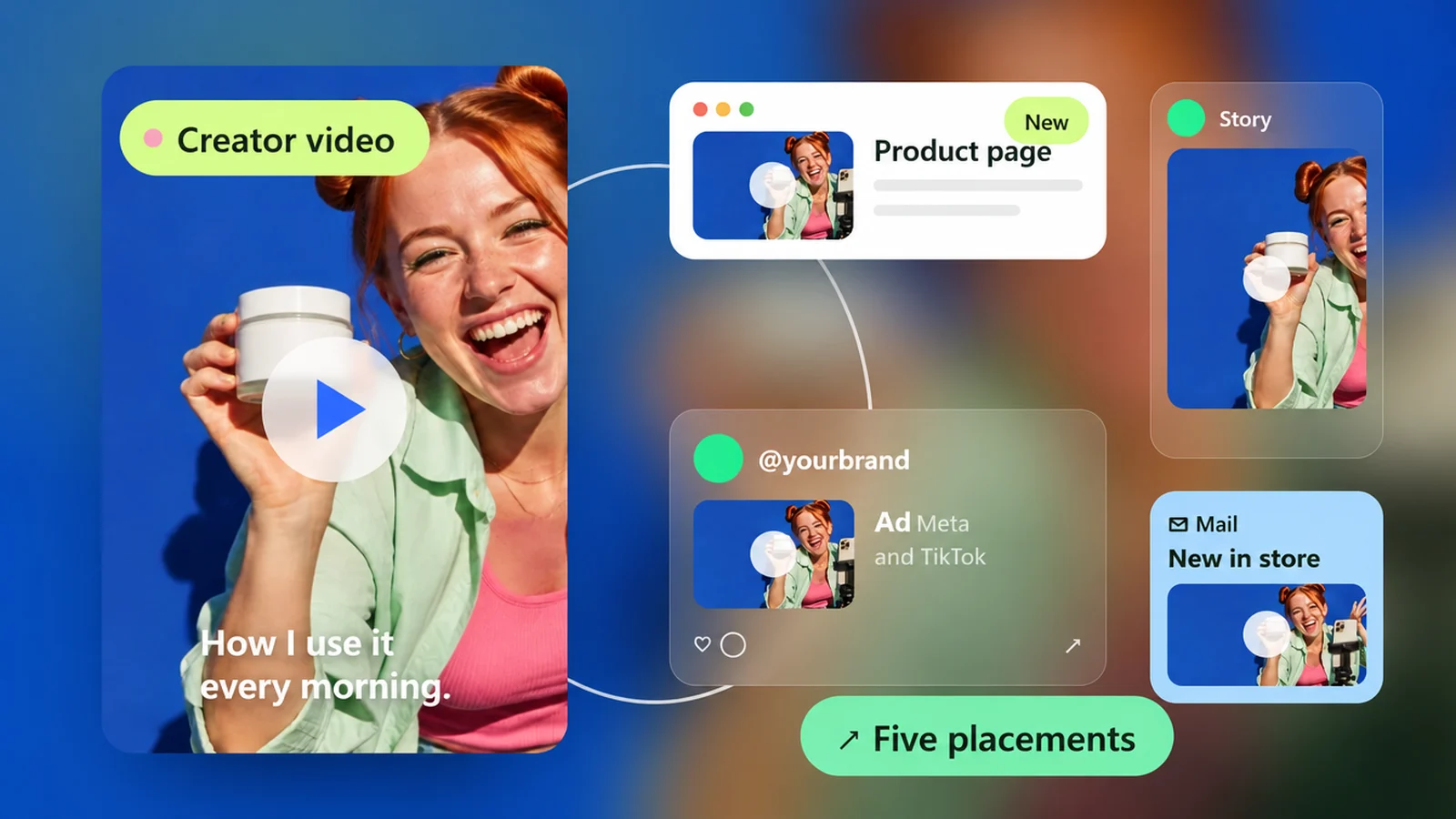
 MetaFacebook, InstagramReel and Story ad, as a Partnership Ad with the creator's name.
 TikTokorganic or Spark AdPosted by the creator, extended as an ad with their approval.
 SnapchatadThe same vertical video as an ad between the content.
 Google AdsYouTubeAs a video ad on YouTube, booked via Google Ads.
 Shopifyproduct pageNext to the product images. Shows what the product looks like in everyday life.
 Klaviyonewsletter, flowsAs a still with a play icon, linked to the video in the store.
If you only think of an Instagram post when you think of creators, you're using one of these places. For ongoing ads, what counts most is the volume of new creatives: if you show the same three videos for months, you're showing them to the same people for the tenth time. The winners then move to the product page and into your email flows.

The produced part, meaning brand film and visual world, we develop with you if needed as a branding agency.
How do Partnership Ads work on Meta?
A Partnership Ad runs with the creator's name but is paid for and managed from your ad account. Meta used to call the format branded content ads. You need the creator's permission, and Meta distinguishes two kinds:
Partnership Ads: two kinds of permissionOn TikTok, the counterpart is called Spark Ads. There, the duration of the permission can be set.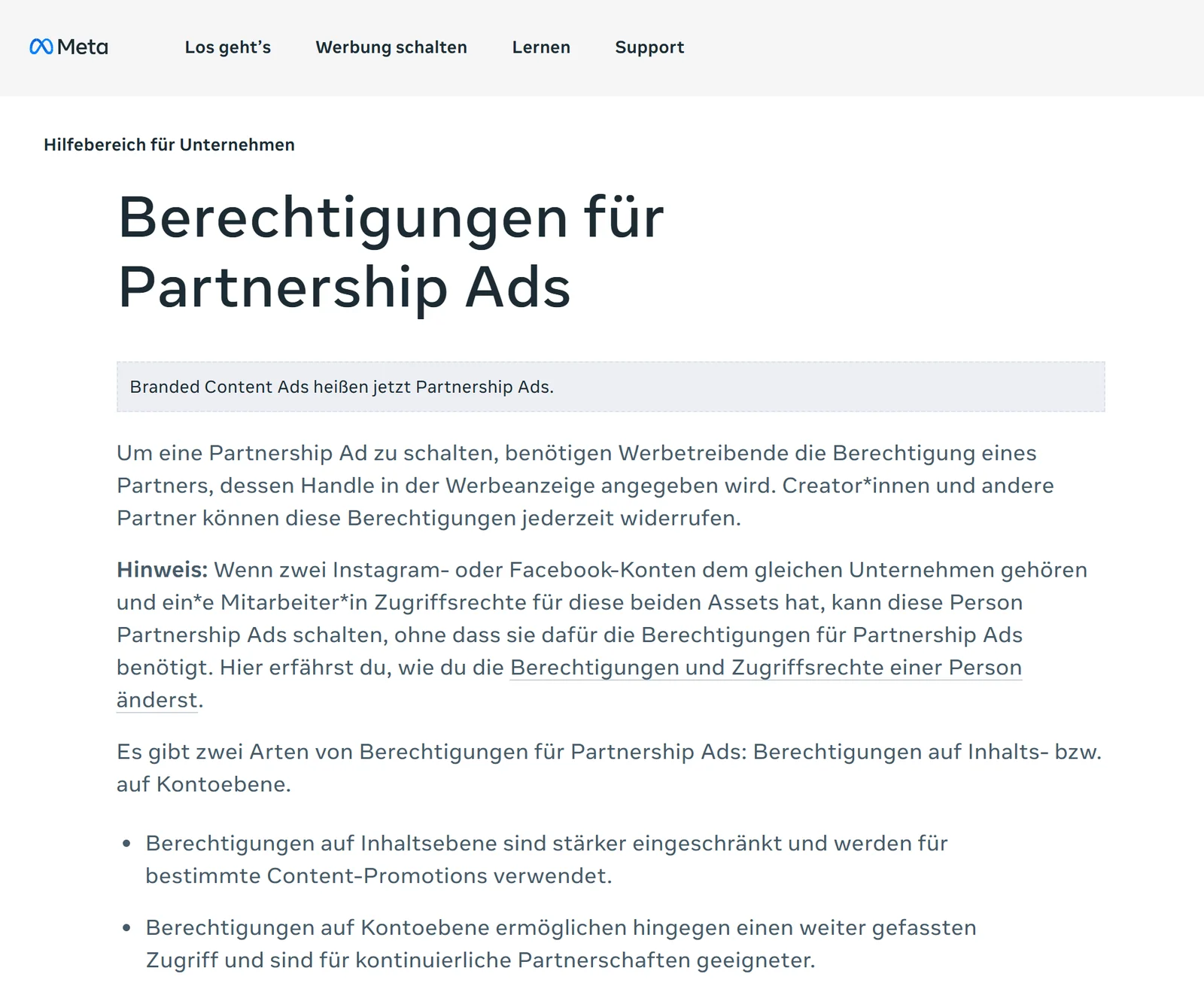
We also run Partnership Ads ourselves as part of our performance marketing; more on that at our Meta Ads agency. More important than who runs them: the permission belongs in the agreement, not in a later message.
What does a good UGC briefing look like?
A good briefing fits on one page and follows four steps: hook, problem, demo, CTA. The creator should know what they need to show. How they say it is up to them.
Rights and disclosure, briefly and without legal advice
The creator remains the author; you get usage rights. Under German copyright law (§ 31 (5) UrhG), anything not explicitly stated in the contract is, in case of doubt, only transferred as far as the purpose of the contract requires. A video “for Instagram” then doesn't automatically include ads, product page and newsletter. Put it in writing: channels, duration, countries and whether you may edit.
If the creator posts themselves and gets money, commission or a product for it, the post must be recognizable as advertising. In Germany, the Federal Court of Justice confirmed this for paid posts in September 2021. Commission links, gifted products and the specific labeling are described in the guideline of the German media authorities. For the agreement, ask a lawyer specializing in media and IT law.
How do you find the right UGC creators?
You usually find the best ones among your own customers, then on platforms and through agencies.
A few good creators beat many free samples sent out. If you send a hundred parcels, you have no influence over what gets posted. Ten creators who deliver every month and share in the sales build you a library to test.
“With this targeted influencer, who was already reaching potential buyers, the quality of the visitors increased very significantly.”Manufacturer, sellerforum.de (translated from German)
If you want to turn customers into creators, you first need customers who like coming back: that's customer retention.
Who UGC isn't worth it for (yet)
UGC is worth it if …
- you run ads and constantly need new creatives.
- your product has a visible moment: unboxing, use, before and after.
- visitors already buy and you want more of them.
Not yet if …
- you don't run ads and have few visitors. Then there's no place for the video to work.
- your product has no visible moment. Then UGC quickly looks staged.
- visitors come but don't buy. Then the problem is behind the click, not in the video.
Where visitors drop off after the click is covered in Shopify traffic but no sales.
Frequently asked questions
UGC stands for user-generated content: photos and videos that come from users or creators instead of the brand, and therefore feel like a recommendation. Online stores mainly use them as ads, on product pages and in emails.
They shoot videos about a product on behalf of a brand and deliver the files with the agreed usage rights. Unlike an influencer, they don't have to post them themselves and don't need a large reach.
On the German platform Speekly, €119 to €159 net, depending on length (as of October 21, 2026). According to a guide from May 2026, freelance creators charge €150 to €1,000 per video depending on experience. Rights for ads often cost extra.
A fixed price if you use the video as an ad yourself, because then your ad sells, not the creator's channel. Commission if the creator posts themselves and brings buyers along. Many brands combine both.
Ads that run with a creator's name but are paid for and managed from your ad account. The creator has to approve them and, according to Meta, can revoke the approval at any time.
First among your customers, then on platforms like Speekly, Influee or Collabstr, or through an agency. According to Shopify, Shopify Collabs isn't accepting new creator sign-ups at the moment.
If the creator posts it on their channel and gets money, commission or a product for it, yes, at least in Germany. The German Federal Court of Justice confirmed this for paid posts in 2021; the guideline of the German media authorities describes it for commission and gifted products. For the details in your contract, ask a lawyer specializing in media and IT law.