Shopify Theme or Custom Design? What Premium Themes, Customization and Custom Builds Really Cost
Free Shopify theme, premium theme, customization or custom design: what each path costs in 2026, what it delivers and who it pays off for.

Jason Spizert
Updated on October 21, 2026
Published 6 min read
The short answer
A premium theme in the Shopify Theme Store costs $100 to $500 one-time, and 24 themes are free (as of October 21, 2026). Every theme in the store has to meet the same core features. So with a premium theme you mostly buy layout variations, not the impact of a brand. Whether your store comes across as a brand depends on visual language, product page structure and content, and a custom design only pays off once the framework can no longer reflect how your customers decide to buy.
How much does a Shopify theme cost in 2026?
Between $0 and $500, one-time. 24 themes in the Theme Store are free and come from Shopify itself; the paid ones come from external developers (as of October 21, 2026). Which theme fits which type of store, we compare in Best Shopify Themes 2026: Find the Right One.
Three things many people don't know before buying: you can test any paid theme in the editor with your products first and only pay when you publish. The license covers one store, with no expiration date. Updates are free, and your settings carry over.
The theme price is rarely the big expense. What gets expensive is what comes after: customization, apps and the time until the store looks the way you planned.
There is no price list for customization or custom design. One provider in the Partner Directory only starts at $10,000. And for the same task, moving a custom theme to the current architecture, a merchant in the Shopify Community received quotes of $650 and of over $15,000.
| Path | Cost | Effort | Distinctiveness | Maintenance |
|---|---|---|---|---|
| Free theme, e.g. Horizon or Dawn | €0, 24 themes by Shopify | low: settings in the editor | low with preview content, much higher with your own images and copy | free updates, up to 60 minutes of design support from Shopify from the Basic plan |
| Premium theme from the Theme Store | $100 to $500 one-time, license for one store | low: more settings, otherwise as above | as above, with more layout variations | free updates, support from the theme developer |
| Customized theme | partner entry prices from $49, much more depending on scope | medium: individual blocks get developed | high in the customized spots | updates possible, code changes carry over as long as they don't conflict |
| Custom theme | ranges in the Partner Directory up to $10,000 and beyond | high: concept, design, development | highest, once brand and images are in place | no updates from the Theme Store, maintained by developers or an agency |
Compare quotes by what gets built, not by the final total. What you pay on top of the theme for your plan, fees and apps is calculated in How much does Shopify cost?
Will a premium theme make my store look like a big brand?
Not the theme alone. A premium theme gives you more layout variations, but the same framework as the free ones.
That comes from the Theme Store rules. Every theme has to support the same list of features: sections on every page, filters, images per variant, product recommendations, country and language selectors and more, plus a minimum score for loading speed. The themes differ mainly in their previews. And since May 2025, Horizon has added a series of ten new free themes with theme blocks.
“Would starting with a paid theme help turn visitors into customers?”Question in the Shopify Community, April 2026
“Most themes from theme store convert the same.”Answer in the Shopify Community, April 2026
We see it the same way, with one addition: what customers perceive as a brand sits above the theme, in three layers.
What happens when mainly the bottom layer gets swapped out, a merchant describes in the Community: a new, more colorful theme, plus a local warehouse and new apps. In the week after, two orders at 30 to 60 visitors a day, a real setback for him.
Framework and brand
The theme is the framework. The brand happens in the layers above it.
How do you spot a template store?
Not by the theme, but by the fact that nobody thought the template through. Five signs you can check in your own store:
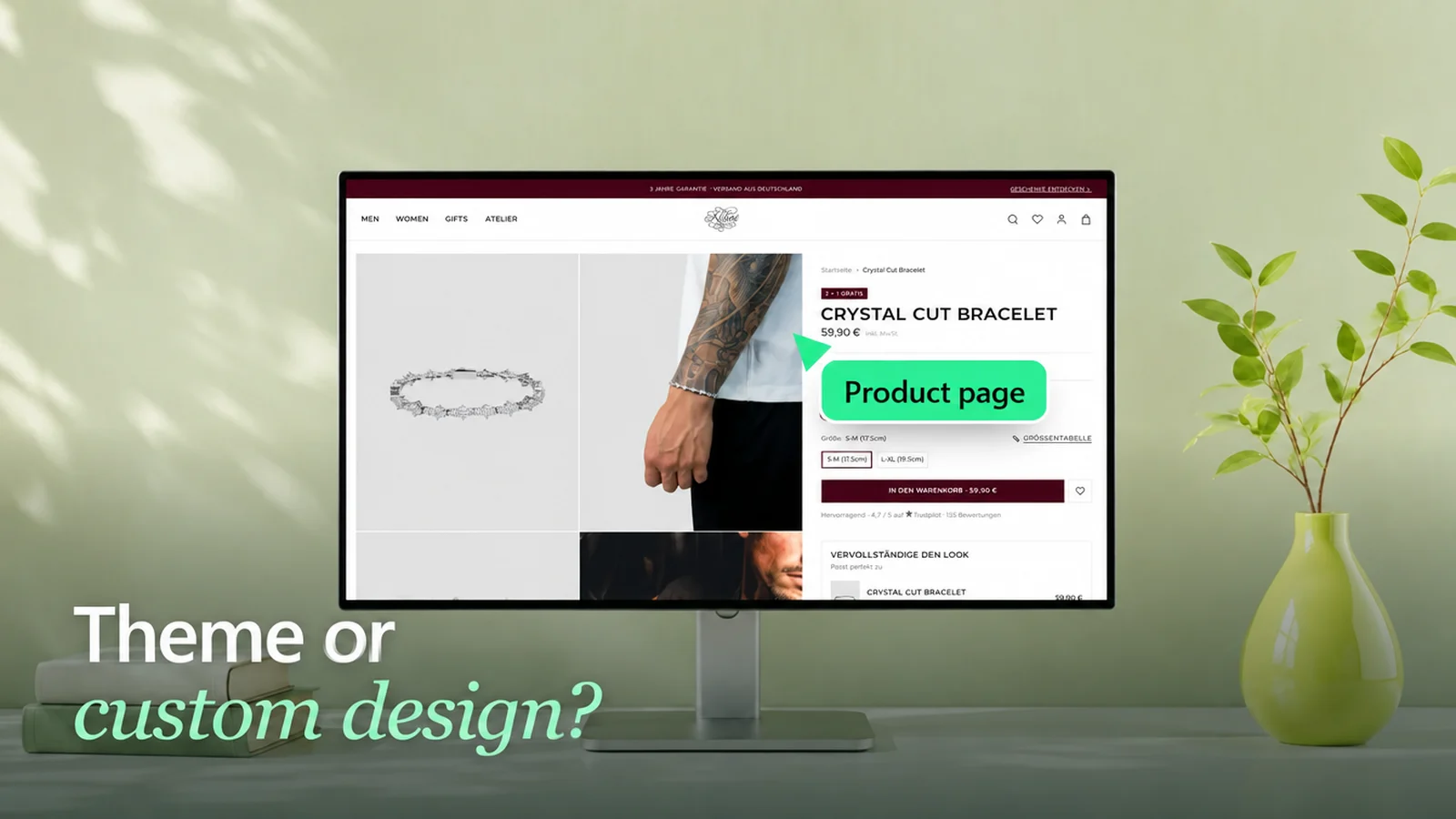
You see it most clearly on the product page. The framework is the same in every theme; the difference comes from the blocks you fill yourself.
The usual reflex against it is to add more:
“I do not want my store to look like a standard Shopify template”Merchant, Shopify Community, September 2026
With every section, animation and banner, he goes on, the store looks busier. What helps against the template feeling is not more elements, but fewer that fit together. Apps are often the biggest foreign bodies; which ones you really need is covered in Shopify apps: which ones a store really needs. Where your store stands, we look at in our conversion optimization work.
Which path fits when?
That depends less on your budget than on what you're missing: a framework, a feature, a building block or a brand.
Whether a customized product page really sells more can be measured instead of guessed. When an A/B test pays off for that and what a good Shopify conversion rate is, we cover in separate articles.
Who is a custom design not worth it for?
For anyone whose product doesn't sell yet, and for anyone without their own images.
A custom design pays off if …
- your product demonstrably sells
- your brand and visual language are in place
- your path to purchase no longer fits into a template
- someone supports the store technically and keeps up with updates
Not yet if …
- you're still testing whether your product resonates: then any fast theme with a clear product page will do
- you don't have your own visual language: a custom theme with a random mix of photos still won't work
- your bottleneck is traffic or your offer: no theme fixes that
- nobody supports the store technically: then a well set up store theme is the more honest choice
Brand and images first, then design: a branding agency helps more with that than any theme. And where exactly visitors drop off, you can find out with Lots of traffic, no sales.
Custom design
A custom design amplifies a brand. It doesn't replace one.
What can a custom design do that a theme can't?
A custom design starts with your customer's buying decision, not with a template. A theme has to work for many industries at once and is therefore built to be neutral. A custom design is allowed to take sides.

For Koluré and Suvene, we redesigned existing stores: what worked stayed, what held them back got rebuilt. How a rebuild like that runs is described on our Shopify redesign page. For Whisky Agents, the store was built completely from scratch; that path is described in Shopify store development. If you're just starting out, read how to create a Shopify store step by step.
The question isn't theme or custom design. The question is which layer your store is missing right now.
Frequently asked questions
In the Shopify Theme Store, 24 themes are free and the paid ones cost $100 to $500 one-time (as of October 21, 2026). The license covers one store and does not expire, and updates from the Theme Store are free.
If you need a specific feature or layout that the free themes don't have. For how your brand comes across, it does little, because every theme in the store has to meet the same core features and the impact comes from images, product page and content.
Yes. You add the theme as a preview, customize it in the editor with your products and only pay when you publish it. Your customizations stay after the purchase.
No. A theme from the Theme Store is licensed only for the store you bought it for. Every additional store needs its own license, otherwise the copy gets no updates.
Horizon is a series of free themes by Shopify, introduced in May 2025. Ten themes came at launch, all with theme blocks that you arrange in the editor.
Online Store 2.0 is the theme architecture Shopify introduced in June 2021. Since then, you can add, remove and move sections on every page, not just the homepage. Every theme in the Theme Store has to support it.
There is no price list; the price depends on page types, features and scope. In the Shopify Partner Directory, providers list ranges for custom store design of up to $10,000 and more. Compare quotes by scope of work, not by the final total.
Not from the Theme Store. Shopify only delivers theme updates for themes installed from there. A custom theme is maintained by your developer or agency.