Shopify Discount Codes, Gift Cards and Bundles: How to Raise Order Value Without Giving Away Margin
Create and combine Shopify discount codes, weigh discounts against margin, gift card or discount, Shopify Bundles and alternatives, strikethrough prices.

Jason Spizert
Published on
11 min read

The short answer
You create discount codes in Shopify under Discounts: as a code to enter or automatic, as a discount on products or the order, as “Buy X get Y” or as free shipping. Each order can use up to five product or order codes plus one shipping code, but only if every discount allows the combination. Do the math first: at a 40% margin and a 20% discount, you need twice as many orders for the same gross profit. Bundles, for example with the free Shopify Bundles app, usually raise order value more cheaply than a bigger discount.
What types of discounts does Shopify have?
Shopify brings four types itself: amount off products, amount off order, “Buy X get Y” and free shipping. You can set up each of them as a discount code or as an automatic discount. Tiered pricing with several levels and bundles need an app.
More important than the type is the class: product, order or shipping. It decides what a discount can be combined with. More on that in a moment.
How do you create a discount code in Shopify?
Under Discounts in the Shopify admin, in six steps. The step that decides your order value is the minimum requirement. A code without a minimum amount only lowers the price.
Create a separate code for each creator and partner. How to use them to measure who actually sells is covered in How to find and vet influencers.
Limits per the Shopify Help Center, October 21, 2026
The most a store can do with discounts
25
automatic discounts active at once, app discounts included
5 + 1
product or order codes plus one shipping code per order
100
customers, products or variants per discount code
20M
unique discount codes per store, in total
1
shipping discount per order, two never stack
30
components in a fixed bundle with Shopify Bundles
Shopify Help Center: discount codes, automatic discounts, combining discounts, Shopify Bundles.
Which discounts can be combined?
Discounts of different classes, yes, but only if every single discount allows the combination in its settings. Shopify then calculates in a fixed order: product first, then order, shipping last.
This is exactly where margin disappears without anyone noticing. Many merchants want a promotion and a code to work together:
“My goal is for customers to always get the best discount on my products.”New store owner, Shopify Community, February 2024 (translated from German)
That's possible. But a 30% weekly promotion as a product discount plus a 10% partner code on the order turns €100 into just €63. Before every promotion, check which codes are already out there and what they can be combined with.
How much more do you need to sell when you give a discount?
Enough that the lower gross profit per order is made up by more orders. The rule of thumb: extra sales needed = discount ÷ (margin − discount). At a 40% margin and a 20% discount, that's 20 ÷ 20, so 100% more orders.
€60 × (40 − 20)% − €0 = €12.00Extra sales needed per discount level at 40% margin5%+14%10%+33%15%+60%20%+100%25%+167%30%+300%35%+700%40%lossOur own simplified calculation, not an industry benchmark. It only compares gross profit: cost of goods stays the same, the discount comes entirely out of your margin. Not included: new customers who later buy again without a discount, customers who would have bought anyway, and returns. Bars capped at 300%.
The reason is simple. Your cost of goods stays the same, and the discount comes entirely out of your margin. Of 40 percentage points of gross profit, a 20% code takes half. With shipping and payment fees per order, it gets even tighter; set them in the calculator.
Remember
A discount lowers your price, but not your costs. It has to pay for itself through more orders or later purchases.
Discounts still aren't wrong. They just have a price you should know beforehand:
A discount is worth it if …
- you want to clear remaining or seasonal stock
- new customers demonstrably come back without a discount
- the code is tied to a threshold that raises the cart value
- you want to measure a channel, such as a creator
Skip it if …
- your margin is below 30% and the discount is in double digits
- customers have already learned to wait for the next code
- the code also goes to regulars who would have bought anyway
- several promotions run at the same time and stack
Whether a new-customer discount pays off through later purchases is shown by customer lifetime value.
How to calculate the value of a customer across all orders is covered in How to calculate customer lifetime value. New-customer discounts belong in that calculation once, not twice: that's explained in How to calculate CAC.
Why are bundles often the better offer?
Because a bundle raises the cart value instead of just lowering the price. Shipping, packaging and payment fee are incurred once per parcel, whether one or three products are inside. A set with a small price advantage therefore often leaves more than a single purchase with a code.
With small carts, exactly this calculation decides whether a store is viable at all:
“Shipping a €5 spice jar on its own simply isn't fun anymore with today's logistics and advertising costs.”E-commerce practitioner in food D2C, LinkedIn, April 2026 (translated from German)
A good bundle isn't a package of slow sellers. It's an offer that solves a problem completely: the care routine instead of one shampoo, the starter kit instead of a single item, a three-month supply instead of one pack. That matches what customers want to buy, and it's harder to compare than a single price.

Test the presentation, not just the price: which set is preselected on the product page, whether the volume tiers sit right next to the add-to-cart button. How to measure such changes properly is part of our conversion optimization. If customers are already dropping off in the cart, read How to reduce cart abandonment first.
Shopify Bundles or another bundle app?
For fixed sets and multipacks, the free Shopify Bundles app is enough. It runs on all Shopify plans, keeps inventory of the individual products in sync and allows up to 30 components per set. It can't do mix-and-match, volume tiers or free gifts.
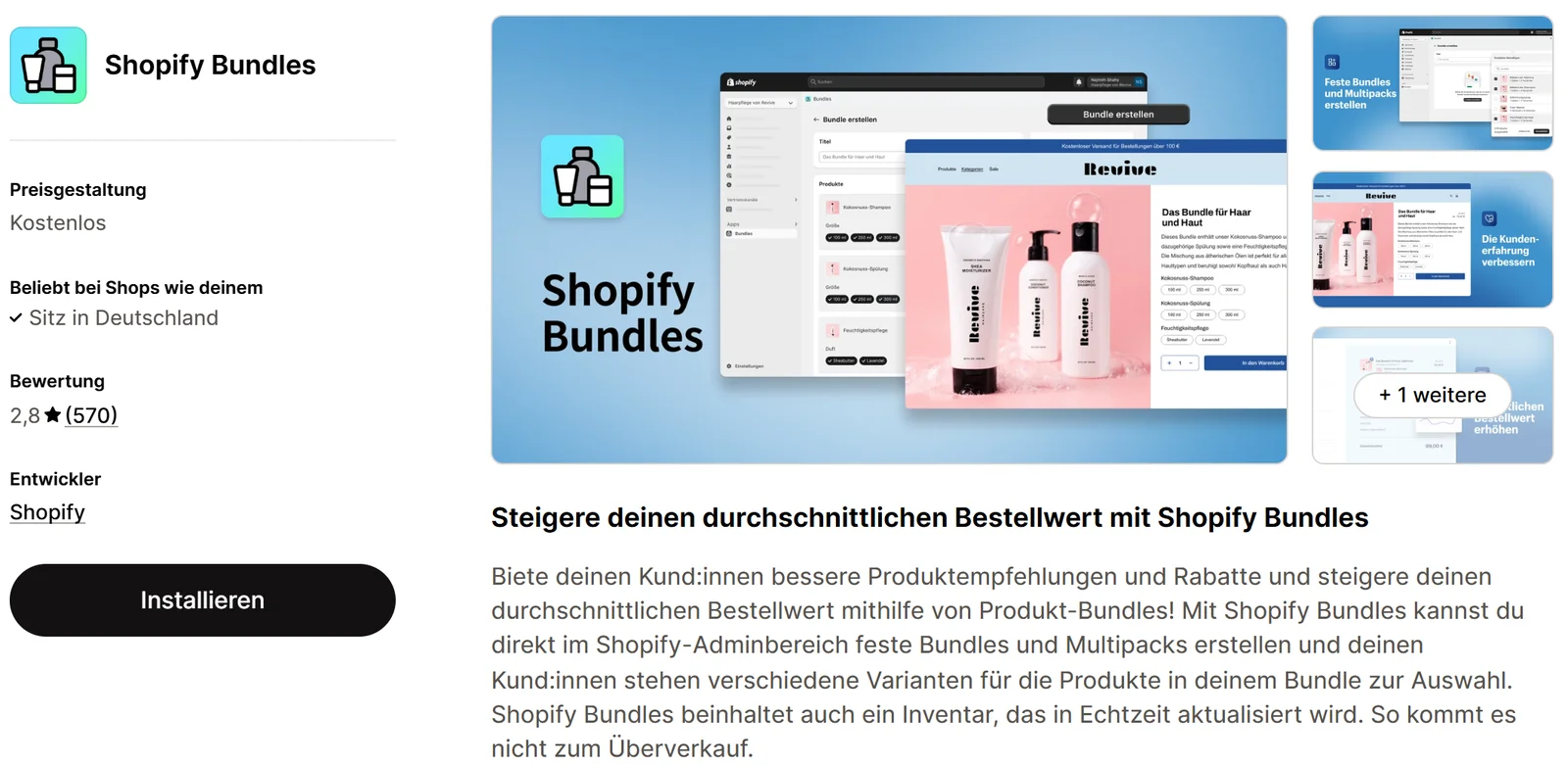
The weak rating has a reason you should know before using it. Bundles have no shipping profiles of their own; Shopify calculates shipping and inventory via the individual products. One merchant writes:
“A bundle containing two products counts as only ONE item for quantity-based free shipping.”Merchant review of Shopify Bundles, Shopify App Store, October 16, 2026
Searching for “bundles” in the App Store returns 4,096 apps. Five examples, selected by number of reviews and features, not a ranking:
| App | Price per App Store | Rating | What it does |
|---|---|---|---|
| Shopify Bundles | free | 2.8 from 570 | fixed bundles, multipacks |
| Kaching Bundles | from $14.99 per month, up to $1,000 additional revenue | 5.0 from 6,421 | volume discounts, bundles, gifts, A/B tests |
| FBP Fast Bundle | from $19 per month, up to $1,000 bundle revenue | 5.0 from 3,583 | fixed and mix-and-match bundles, Buy X get Y, volume discounts |
| Bundler | free plan, Premium $9.99 per month | 4.9 from 2,743 | tiered pricing, Buy X get Y; mix and match from Premium |
| Simple Bundles & Kits | free up to 3 bundles and 50 orders, otherwise from $24 per month | 4.9 from 807 | all bundle types, SKU breakdown |
Watch the pricing model. Kaching and Fast Bundle tier their price by the revenue the app brings in: the better the bundle performs, the more expensive the app. If you sell subscriptions, plan separately: according to the help center, bundles in Shopify don't work with purchase options like subscriptions or pre-orders. More in Shopify subscriptions, and which apps a store needs at all in Shopify apps: which ones your store really needs.
 Discount code or automatic. Product, order or shipping class.01or a bundle app




 Set, multipack or volume tiers. Examples from the Shopify App Store.
 “Placed Order” includes the Discount Codes and Total Discounts fields. That becomes a segment: who came with a code, who without.05Next purchaseFollow-up email without a new codeDiscount buyers get the matching set or refill pack suggested, not the next coupon. That way nobody learns to buy only with a code.
Many forget the last step: Klaviyo receives the code used with every order. That lets you separate buyers who only come with a discount from everyone else and send them a set instead of the next code. How the integration works is covered in How to connect Klaviyo with Shopify.
Gift card or discount code: what's the difference?
A gift card is money; a discount code is a price reduction. Someone paid for the gift card in advance, and at checkout it's applied like a payment, after all discounts. You pay for the discount code yourself, out of your margin.
| Gift card | Discount code | |
|---|---|---|
| What it is | credit with a fixed monetary value | reduction in percent, as an amount or free shipping |
| At checkout | payment method, applied after discounts | lowers the subtotal before taxes |
| Who pays | the buyer, in advance | you, out of your margin |
| VAT (Germany) | single-purpose or multi-purpose voucher, § 3 (14) and (15) UStG | not a voucher, reduces the price, § 3 (13) UStG |
| In Shopify | Products > Gift cards, on all plans | Discounts > Create discount |
Two details from the Shopify Help Center: gift cards sold as products can go up to $10,000, those you create yourself in the admin up to $2,000. And for stores opened on or after May 12, 2025, the third-party transaction fee applies to the amount paid by gift card, except on Shopify Plus with Shopify Payments.
A gift card you give away for free isn't prepaid by anyone. Economically, it's a discount then. For the tax treatment of your cases, ask your tax advisor.
Selling in Germany: strikethrough prices and sales
If you announce a price reduction on a product to consumers in Germany, you have to state the lowest total price of the 30 days before the reduction. That's what § 11 (1) of the German Price Indication Ordinance (PAngV) says. This is information, not legal advice.
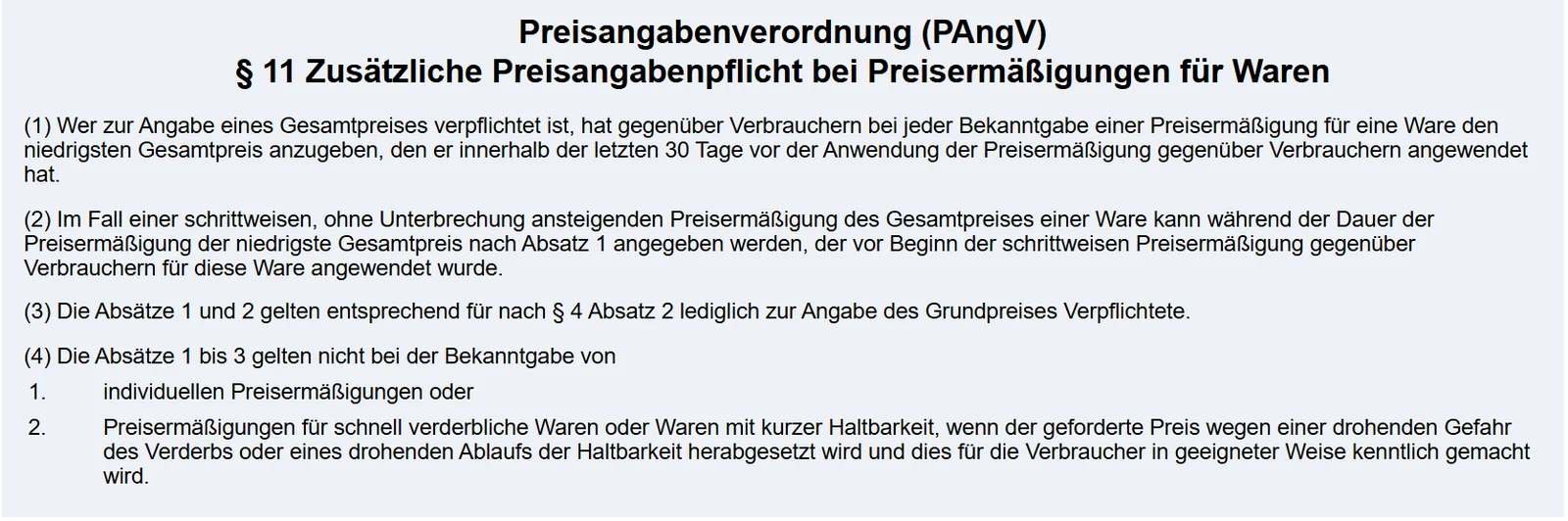
The Court of Justice of the European Union (CJEU) followed up on September 26, 2024 (C-330/23): a percentage discount must refer to this lowest price, not to the usual price before it. If you already reduced the price three weeks ago, you advertise with smaller percentages.
In Shopify, you enter the strikethrough price in the compare-at price field. Whether your theme or an app adds the 30-day price is something you check yourself. Whether a discount code from your newsletter counts as an individual price reduction is best clarified with a lawyer specializing in IT law. Wholesale pricing and volume tiers follow their own path, see Shopify B2B.
If you want to know where your store is leaving order value on the table today, book the free call below.
Frequently asked questions
In the Shopify admin under Discounts, click “Create discount”, choose the type and set the method to “Discount code”. Then set the value, products, minimum requirement, customer eligibility, usage limit, combinations and dates, and save.
Yes, up to five product or order codes and one shipping code per order. That only works if every discount involved allows the other's class in its combination settings. Product plus order discounts only work in eligible stores without checkout.liquid.
A gift card is prepaid credit and is applied at checkout like a payment. A discount code lowers the price, and the money for it comes out of your margin. Under German VAT law, a pure discount code is not a voucher (§ 3 (13) UStG).
No, Shopify Bundles is free and available on all Shopify plans. It handles fixed bundles and multipacks, but not mix-and-match bundles and nothing combined with subscriptions. For that you need a different app.
Calculate the extra sales you need: discount ÷ (margin − discount). At a 40% margin, a 10% discount needs 33% more orders, a 20% discount already 100% more. If the discount equals your margin, you no longer make money on any order.
One tier works with built-in tools: an amount-off discount with a minimum quantity of items, such as 10% off 3 or more. Shopify explicitly names several tiers as a case for apps, and on Shopify Plus also for Checkout Blocks.
If you sell to consumers in Germany and announce a price reduction on a product, yes: § 11 PAngV requires the lowest total price of the last 30 days. According to the CJEU, a percentage discount must refer to this price. This is not legal advice; for your specific case, ask a lawyer specializing in IT law.